

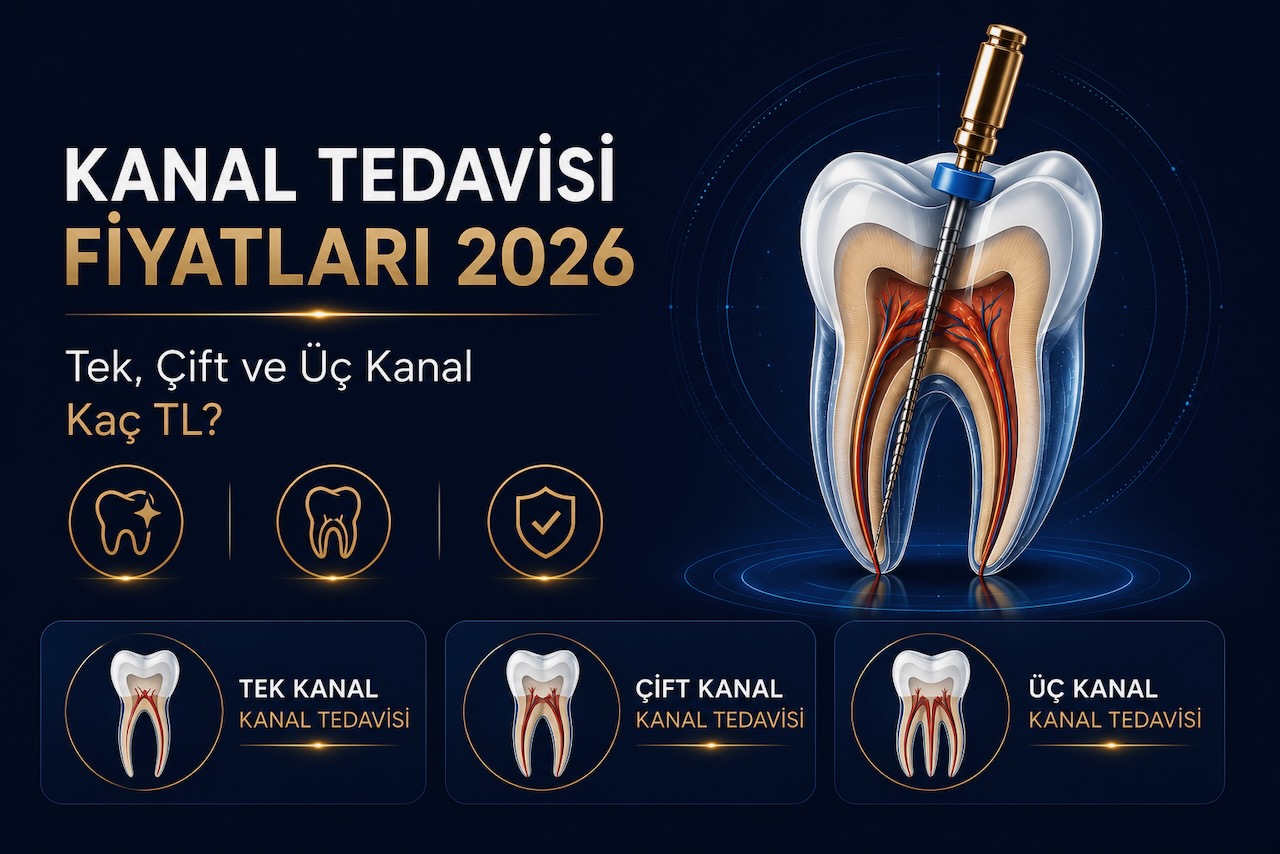
When a toothache becomes unbearable, root canal therapy is often the most effective way to save a tooth damaged by decay or trauma instead of extracting it. For patients from the US and the UK, root canal treatment in Turkey is attractive because the same modern techniques, rotary files, apex locators and dental microscopes, are available at a fraction of the price at home. A root canal is simply the removal of inflamed or dead tissue from inside the tooth and its replacement with a special sealing material.
In this guide we explain root canal treatment in Turkey for 2026: prices for single, double and triple canal teeth in USD and GBP, the Turkish Dental Association (TDB) guideline tariff, the step-by-step procedure, the latest technology and how to plan treatment during a trip to Istanbul. You will find clear, evidence-based answers to the questions patients ask most.
Important: this content is for information only and does not replace a clinical examination. Your diagnosis and price are confirmed after an examination and X-rays.
What Is Root Canal Treatment and When Is It Needed?
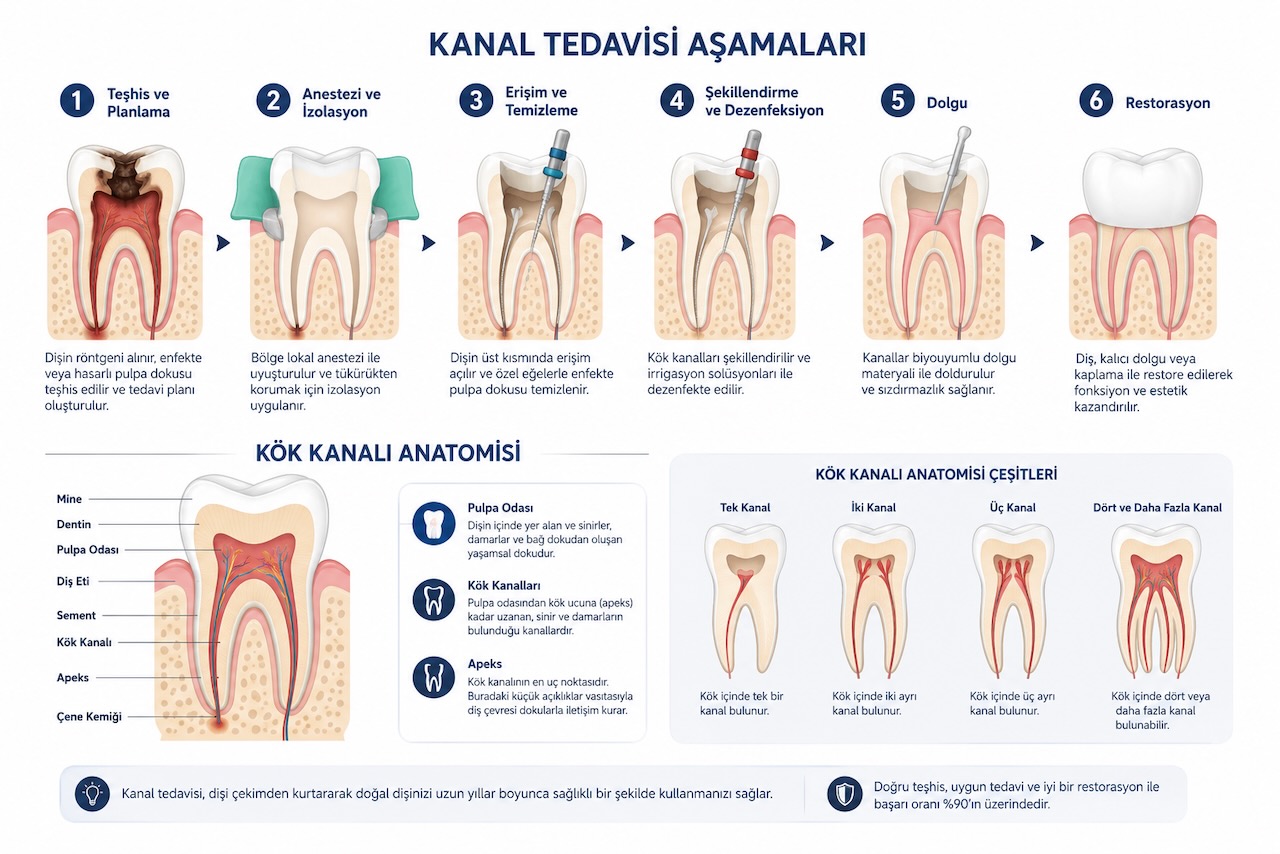
Root canal treatment is an endodontic procedure performed when the soft tissue inside the tooth, the pulp, is irreversibly damaged. A tooth consists of enamel on the outside, dentin beneath it and the pulp, with its blood vessels and nerves, at the centre. When decay reaches the pulp or the tooth suffers a strong blow, the tissue becomes inflamed and eventually dies. At that point, a root canal is usually the only way to save the tooth.
The goal is to remove infected tissue completely, disinfect the canals and seal them so the tooth can keep functioning. Modern dentistry sees the root canal as the cornerstone of a conservative approach that keeps natural teeth rather than extracting them, because no implant or bridge can fully replicate a natural tooth. With the right indication, a treated tooth can last for many years, often for life. That is why root canal treatment in Turkey is usually the first option our dentists discuss before any extraction.
Pulp and Root Canal Anatomy
The pulp is not just a nerve; it is living tissue containing blood vessels, nerve fibres, connective tissue and cells that produce dentin. It fills a pulp chamber in the crown and continues down through narrow root canals to the root tips. Front teeth usually have one canal, while molars can have three or more. This is one of the main factors in the price of root canal treatment in Turkey, because more canals mean more time, more difficulty and a higher cost.
At the tip of each root is the apex, a tiny opening where vessels and nerves enter the tooth. If infection spreads beyond the apex into the bone, a periapical lesion or abscess develops. A key task during treatment is to clean and fill the canal exactly to the apex, neither short nor beyond, which is why electronic apex locators are essential in modern root canal treatment in Turkey.
Signs You May Need a Root Canal

- Deep decay: the most common reason. Once bacteria reach the pulp, a simple filling is no longer enough.
- Trauma and fractures: a fall or sports injury can expose or damage the pulp; a tooth that turns grey after a blow often needs a root canal.
- Abscess and swelling: infection spreading into the jawbone causes throbbing pain, swelling and sometimes fever. Antibiotics alone cannot cure a dental abscess permanently; the source must be removed by root canal treatment or extraction.
- Irreversible pulpitis: severe, spontaneous pain that lingers after hot or cold and gets worse at night usually means the pulp can no longer heal.
- A failed previous root canal: an old treatment can become reinfected and may need retreatment.
Before root canal treatment in Turkey begins at Akdiş Clinic, each of these situations is assessed with digital imaging and a detailed examination before treatment, so we can determine accurately whether the tooth can be saved.
“Killing the Nerve”: What Really Happens?
Many people call a root canal “killing the nerve”, but the whole pulp, including vessels, connective tissue and cells, is removed. Another myth is that a root-filled tooth is “dead” and will inevitably rot. In reality, the tooth loses its internal blood supply but is still nourished by the surrounding tissues and can function for many years, especially when protected with a crown. A root canal does not kill a tooth; it saves it from extraction. Old methods such as arsenic paste are no longer used; today treatment is a controlled mechanical cleaning under local anaesthesia.
How Is Root Canal Treatment Done? Step by Step
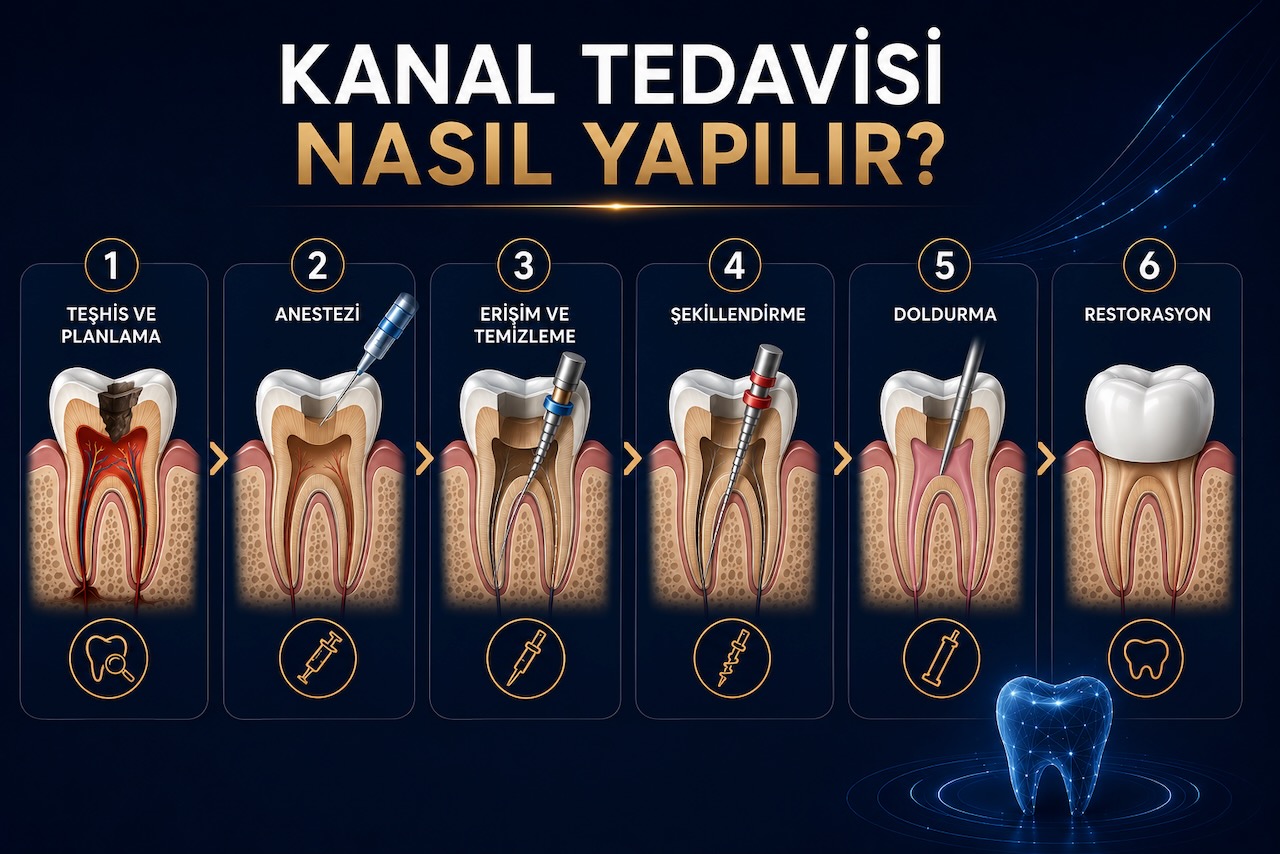
Not knowing what happens often causes unnecessary anxiety. Modern root canal treatment in Turkey follows standard, predictable steps: diagnosis, anaesthesia, cleaning, shaping and filling the canals, and finally restoring the tooth.
Examination, Digital X-rays and Diagnosis
Your dentist listens to your symptoms, then examines the tooth for decay, fractures, discolouration or gum swelling. Because the inside of the tooth cannot be seen, digital X-rays are the foundation of planning root canal treatment in Turkey: they show the number and shape of the roots, curvature, any lesion at the root tip and whether infection has spread. In complex cases, 3D CBCT reveals extra canals and anatomical variations that standard X-rays miss. Cold tests or electric pulp tests help confirm whether the pulp is alive or necrotic.
Anaesthesia and Removal of Infected Tissue
During root canal treatment in Turkey, local anaesthesia numbs the tooth and surrounding tissues completely, so you feel no pain. A thin rubber sheet called a rubber dam is then placed to isolate the tooth from saliva and bacteria, which is crucial for success. Through a small opening in the crown, the inflamed or dead tissue is carefully removed from the pulp chamber and canals, and the canals are rinsed repeatedly with antibacterial solutions, usually sodium hypochlorite, to eliminate microorganisms you cannot see.
Shaping the Canals and Filling With Gutta-Percha
In root canal treatment in Turkey at our clinic, the canals are then enlarged and shaped into a tapered form with fine instruments. Today, flexible nickel-titanium rotary files driven by an endomotor make this faster and more consistent, even in curved canals, while an apex locator measures the exact length. The canals are then filled with gutta-percha, a biocompatible natural polymer, together with a sealer, leaving no gaps. Because gutta-percha shows up on X-rays, the dentist can check the quality of the filling immediately.
Final Filling or Crown
Treatment is not finished until the tooth is permanently restored. A root-filled tooth can become more brittle, and an unsealed access opening can let bacteria back in. Teeth with small tissue loss may need only a composite filling, but back teeth with significant tissue loss should receive a crown, which acts like a helmet and greatly extends the tooth’s life. Studies show that after root canal treatment in Turkey or elsewhere, crowned molars survive much longer than those restored with fillings alone. Note that the crown is usually priced separately from root canal treatment in Turkey, so ask about it when you request a quote.
Root Canal Treatment in Turkey: 2026 Prices
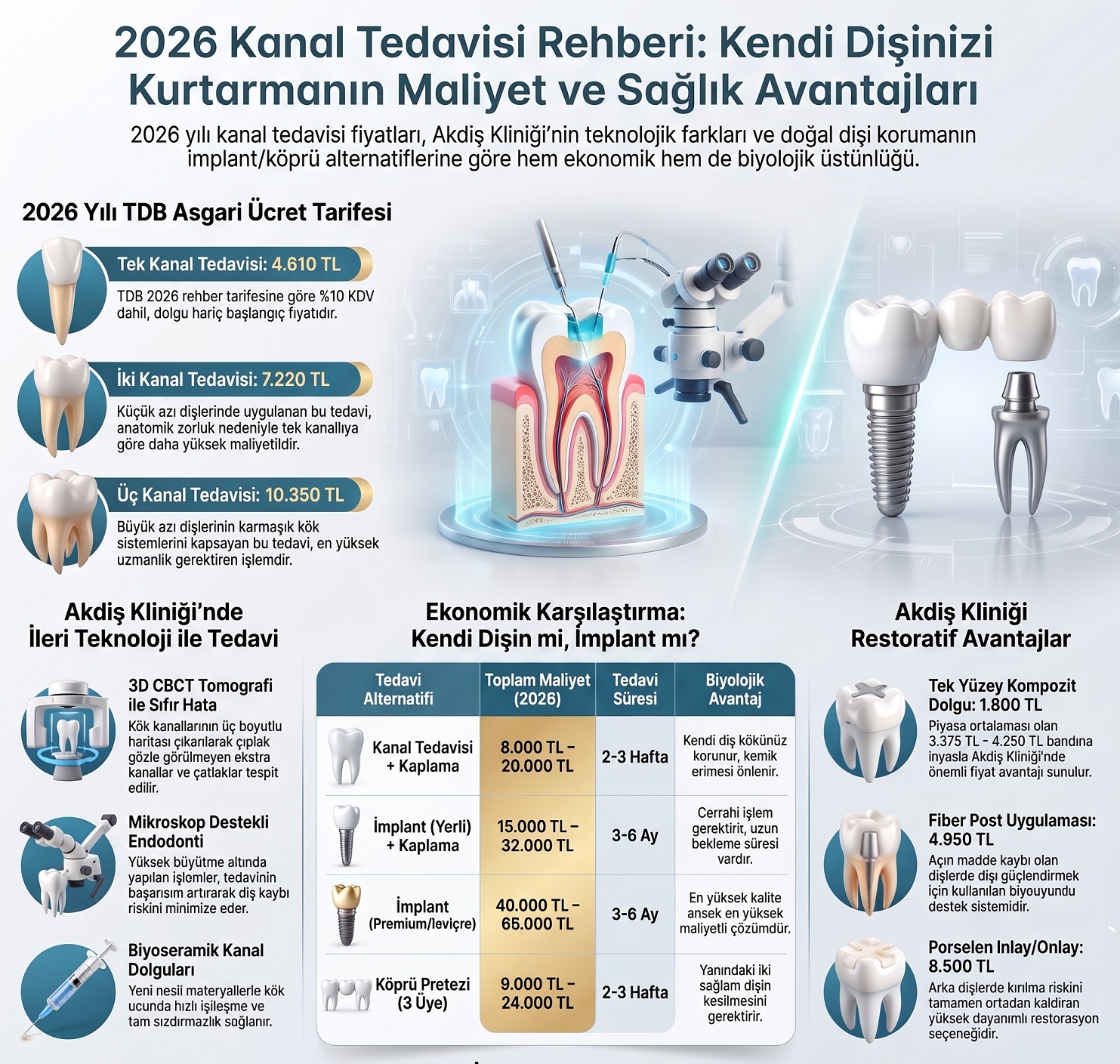
Price is one of the most researched topics. The cost of root canal treatment in Turkey depends on the city, the dentist’s specialisation, the technology used and, above all, the number of canals. The table below shows typical 2026 ranges, converted from Turkish lira and rounded up. Your exact price is confirmed after an examination and X-ray.
| Procedure | 2026 range (USD / GBP) | Note |
| Single canal (filling excluded) | $70 – $100 / £50 – £80 | TDB 2026 tariff about $100 |
| Double canal | $150 / £110 – £120 | TDB 2026 reference |
| Three or more canals | $210 – $220 / £160 | TDB 2026 tariff |
| Baby tooth root canal | $60 – $140 / £50 – £110 | Depends on the case |
| Private clinic average | $60 – $310 / £40 – £240 | Wide range depending on complexity |
| Open apex treatment (per canal) | $240 / £180 | TDB 2026 tariff |
| Apicoectomy (single root, filling excluded) | $200 – $290 / £150 – £220 | Increases with the number of roots |
| Microscope-assisted treatment | About 30% more | Technology difference |
Prices vary with the clinic, the dentist’s expertise, the number of canals and the condition of the tooth (infection, lesion or retreatment). A crown is usually not included. For a personal quote, contact us through our contact page.
How Does Root Canal Treatment in Turkey Compare With the US and UK?
In the United States, a root canal commonly costs around $700 to $1,100 for a front tooth and $1,000 to $1,500 or more for a molar, before the crown. In the UK, private fees are typically £300 to £700 for a front tooth and £600 to £1,200 for a molar, and more with a specialist endodontist. By comparison, root canal treatment in Turkey often costs less than a quarter of these fees, even with the microscope. Many patients combine a root canal with crowns, veneers or implants during one trip.
What Affects the Price?
- Number of roots and canals: the main factor in root canal treatment in Turkey; more canals mean more complexity.
- Infection and lesions: teeth with an abscess or periapical lesion may need extra sessions and medication.
- Location of the clinic: big cities have higher running costs.
- Technology: microscopes, rotary systems, apex locators and lasers increase success but also cost, for example about 30 percent more for microscope treatment.
- Dentist’s title: a specialist endodontist is preferred for difficult cases and retreatments and may charge more, but also improves the chance of success.
TDB 2026 Guideline Tariff and Private Clinics
The Turkish Dental Association publishes a guideline tariff every year. It is a reference, not a binding price list, so private clinics may charge below or above it. In 2026, the guideline for a single canal is about $100 (£80) and for three canals about $220 (£160). When comparing root canal treatment in Turkey, look beyond the number at the technology, the dentist’s experience and the aftercare offered. Akdiş Clinic combines modern endodontic equipment with experienced dentists to offer high success rates and transparent pricing. Learn more on our root canal treatment page.
Planning Root Canal Treatment During Your Trip to Istanbul
For international patients planning root canal treatment in Turkey, timing matters. Straightforward cases are often completed in a single visit, while infected teeth may need two or three sessions a few days apart, which still fits comfortably into a one-week stay. If a crown is needed afterwards, a zirconia crown can usually be made during the same trip. If you are also planning veneers or implants, treating infected teeth first is essential, because cosmetic work should always be built on a healthy foundation. Send us your recent X-rays before you travel, and we will estimate the number of visits in advance.
Is Root Canal Treatment Painful? Sessions and Recovery
Pain During Treatment: The Reality of Modern Anaesthesia
With proper anaesthesia, root canal treatment in Turkey does not hurt. Modern local anaesthetics numb the tooth completely, and for many patients the procedure brings relief from the pain caused by inflammation. In teeth with an acute abscess, anaesthesia can be harder to achieve because of the acidic environment, but supplementary techniques ensure comfort. Today, the experience is similar to having a filling.
How Many Sessions and How Long?
Simple cases of root canal treatment in Turkey are often completed in one session. When infection has spread, a calcium hydroxide dressing may be left in the canals for about a week, extending treatment to two or three sessions. A single-canal tooth usually takes 30 to 45 minutes, while a molar session may take 60 to 90 minutes. Studies show no significant difference in success between single-visit and multiple-visit treatment in non-infected teeth.
Recovery After Treatment
After root canal treatment in Turkey, mild tenderness when the anaesthetic wears off is normal and usually fades within 2 to 3 days, disappearing completely within a week. Simple painkillers help. Severe or worsening pain, noticeable swelling or fever is not normal and should be reported to your dentist. Avoid chewing hard foods on the tooth until the final filling or crown is placed.
New-Generation Root Canal Technology (2026)
- Dental microscope: now standard in advanced root canal treatment in Turkey, it magnifies the canals up to 20 times, revealing extra canals, cracks and broken instruments, and greatly improves success in complex cases.
- Apex locator: electronically measures canal length, reducing the need for X-rays and improving safety.
- Rotary and reciprocating files: flexible nickel-titanium files controlled by an endomotor shorten treatment and standardise quality.
- Laser-assisted disinfection and SWEEPS: laser-activated irrigation drives disinfecting solutions deep into lateral canals and biofilm.
- Regenerative endodontics: stem cell research aims to regenerate pulp tissue in young teeth, although most of these methods are still at the research stage.
Failed Root Canals and Retreatment
When performed correctly, a root canal has a high success rate, usually reported at 85 to 95 percent, but no treatment is 100 percent guaranteed. Warning signs of failure include recurring pain, tenderness when biting, recurring gum swelling or a small draining spot (fistula), discolouration and a new lesion on X-rays. Causes include missed extra canals, incomplete filling, insufficient disinfection, leaking restorations and new decay or fractures.
There are two solutions. Retreatment re-enters the tooth, removes the old filling, cleans and disinfects the canals again and refills them; it is usually the first choice. Apicoectomy is a minor surgical procedure in which the infected root tip is removed through the gum and sealed. Your dentist decides based on the type of infection, the existing restoration and the root anatomy. Both aim to save the tooth, and microscope-assisted root canal treatment in Turkey greatly improves the chance of success in these cases.
Root Canal or Extraction?
Whether you choose root canal treatment in Turkey or at home, the principle of modern dentistry is clear: keep the natural tooth whenever possible. It provides a natural chewing feel, harmony with surrounding tissues and protection of the jawbone. Extraction followed by an implant should be considered only when the tooth truly cannot be saved, for example with a vertical root fracture, extensive tissue loss or advanced bone loss. Extracting a savable tooth with the idea of “I will just get an implant” is often more expensive and biologically less favourable. If you do need an implant, see our guide to dental implant prices in Turkey.
Aftercare Following a Root Canal
- Do not delay the final restoration: the temporary filling is not permanent; get the filling or crown done as soon as possible.
- Take crown advice seriously: crowns protect back teeth from fracture and greatly increase survival.
- Avoid hard foods such as nuts or ice until the tooth is restored.
- Keep up good hygiene: a root-filled tooth can still decay; brush twice a day, floss and have regular check-ups.
- Attend follow-up X-rays: they show whether the area around the root tip is healing properly.
Frequently Asked Questions
How much does a root canal cost in Turkey in 2026?
For root canal treatment in Turkey, typical fees are about $70 to $100 (£50 to £80) for a single canal, about $150 (£110 to £120) for two canals and about $210 to $220 (£160) for three or more canals. A crown is priced separately.
Is it worth travelling to Turkey for a root canal?
A root canal alone may not justify a trip, but many patients combine it with crowns, veneers or implants, which makes root canal treatment in Turkey excellent value compared with US and UK fees.
Can a root canal be done in one day?
Yes. In many cases without extensive infection, root canal treatment in Turkey is completed in a single day. Infected teeth may need two or three sessions, which usually fit into a one-week stay.
Do I need a crown after a root canal?
Back teeth with significant tissue loss usually need a crown to prevent fractures. Front teeth with minimal loss can often be restored with a filling.
Conclusion
Root canal treatment in Turkey saves your natural tooth, stops pain and prevents infection from spreading. With modern anaesthesia, rotary files and microscopes, treatment is comfortable, predictable and affordable. If you are considering root canal treatment in Turkey, send us your X-rays through our contact page and our team at Akdiş Clinic will prepare a personalised plan and quote.
One thought on “Root Canal Treatment in Turkey 2026: Single, Double and Triple Canal Prices and the Best Painless Methods”