

What is Orthodontic Treatment?
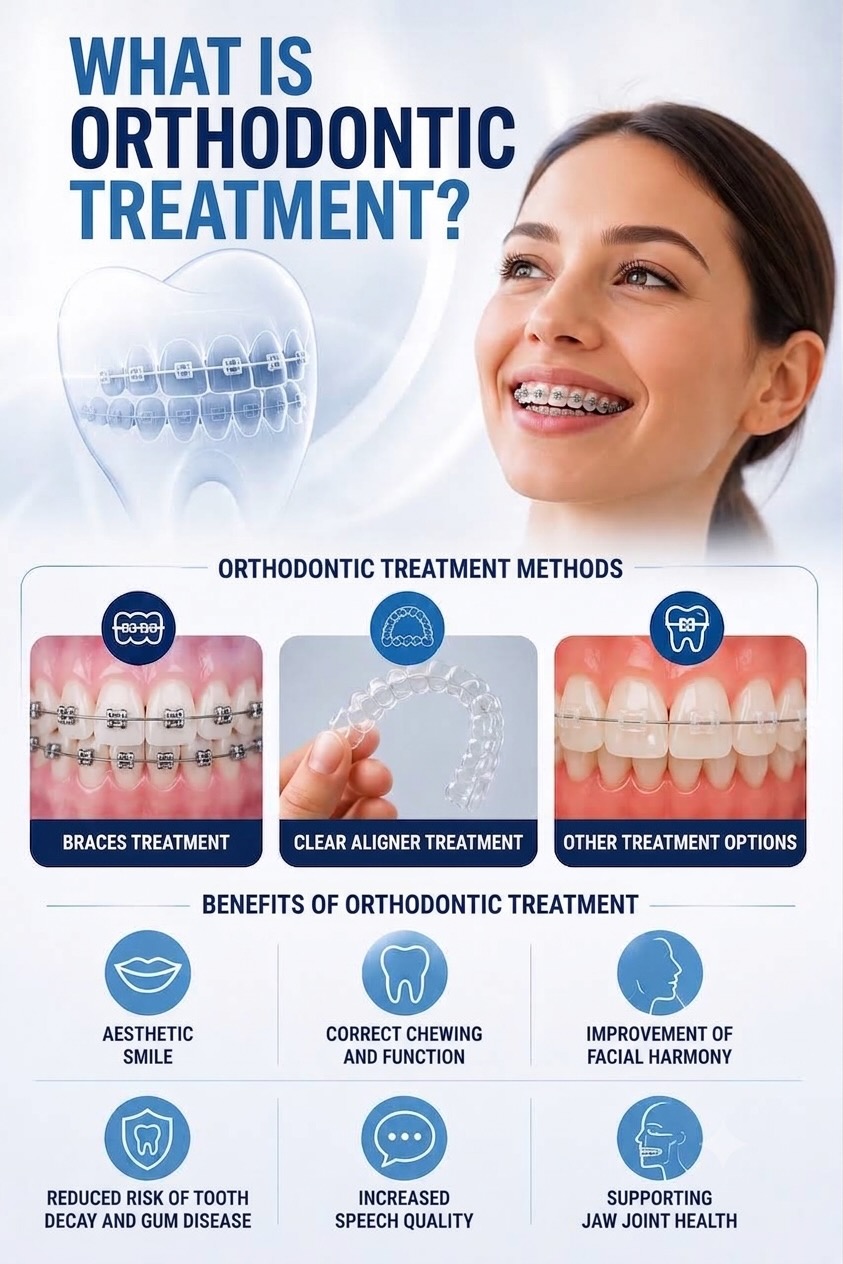
Orthodontics is the specialty that examines, diagnoses and treats the locations of the teeth on the jaw bones, their relations with each other, and the anomalies of the jaw. The origin of the word is derived from the Greek words “orthos” (proper) and “odous” (tooth). In modern medical literature orthodontics This department, called the so-called, aims to not only eliminate aesthetic concerns, but also optimize chewing function, speech disorders and general oral and dental health. In the intraoral ecosystem, the intricate, intermittent or incorrect positioning of the teeth paves the way for the accumulation of food residues, gum diseases and tooth decay. Orthodontic treatments minimize these risks by ensuring that teeth are brought to a functional plane.
Broad-spectrum orthodontic treatments administered in our clinic aim to restore optimal anatomy in both children and adults by directing the development of the jaw skeleton. The movement of the teeth in the jawbone is carried out by the application of controlled biomechanical forces. These forces trigger bone destruction and re-bone formation processes at the cellular level. While the bone tissue in the direction of the tooth moves, new bone tissue is synthesized in the opposite direction. Therefore, these treatment processes are the combination of a biological miracle with controlled medicine practices. Our specialist orthodontists working in the Akdiş Clinic form the treatment plan by analyzing the specific bone density, periodontal health and general clinical picture of each patient.
Who is orthodontic treatment suitable for?
Orthodontic treatments are suitable for all individuals with healthy periodontal tissues (gum and bone support) without age restrictions. These treatment models, which have been perceived as an intervention only for children and adolescents in the past years, are frequently preferred by adult patients thanks to the developing material science and digital planning technologies. There is a wide range of patients, from interceptive (preventive) approaches applied in childhood to pre-orthodontic corrections in advanced ages. The main condition is that the alveolar bone and gingival tissue surrounding the teeth are free from an active infection.
Since growth and development are completed in adults, correction of skeletal anomalies may require surgical support, while dental movements can be performed safely at any age. In this direction, everyone can benefit from these treatments, including business professionals with high aesthetic expectations, young people looking for solutions that are not noticed in their social life, and elderly individuals with functional chewing problems. Each of our patients who applied to our clinic is included in the process by evaluating a detailed clinical examination, digital analyzes and volumetric tomography.
In which situations is orthodontic treatment necessary?
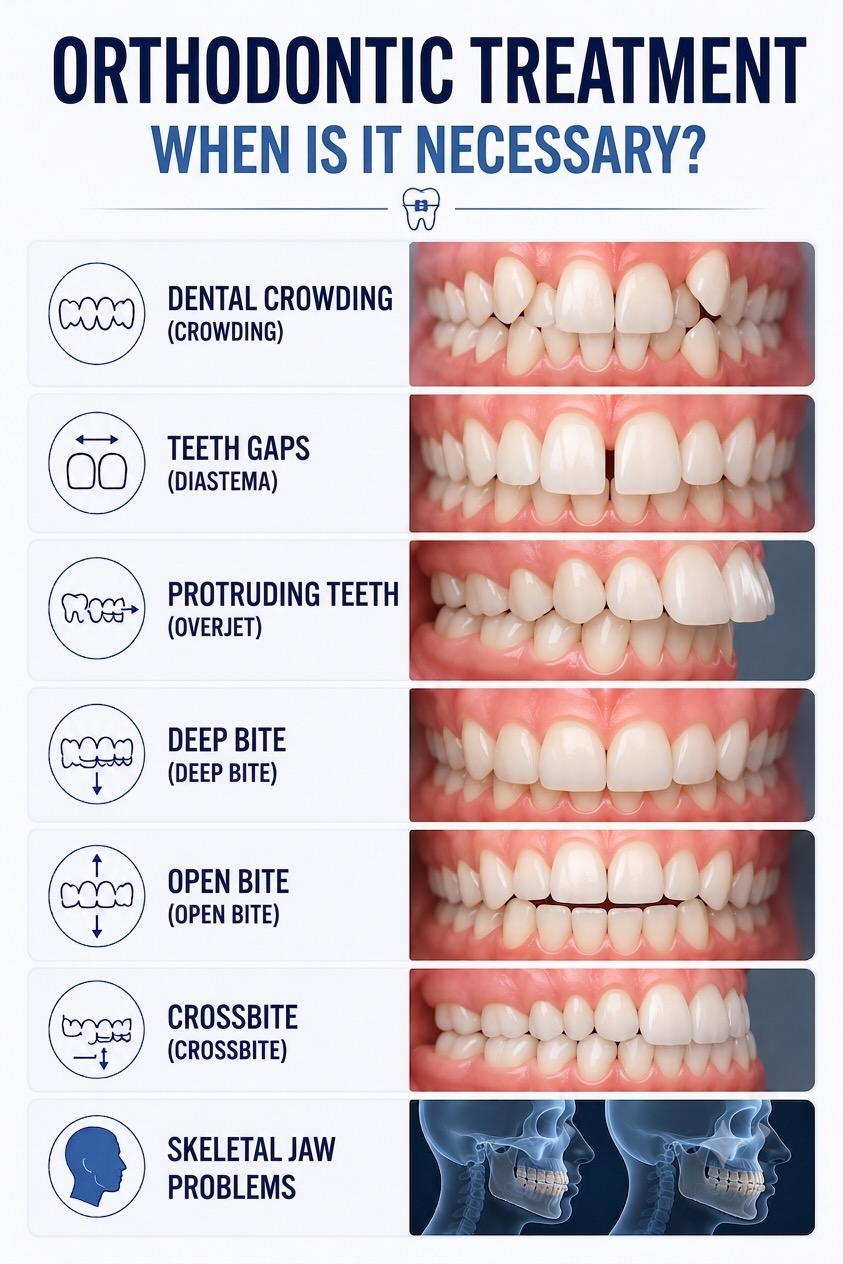
Generally, the deviation of teeth and jaws from the normal anatomical relationship malocclusion (bad closure) is called. Orthodontic treatments are activated to provide functional and aesthetic rehabilitation in all of these types of malocclusion. The main clinical conditions in which treatment is required can be summarized as follows:
- Dental Conversion (Crowding): In cases where the jawbone is too small to meet the total width of the teeth, the teeth overlap, rotate or out of the arc. This situation makes it very difficult to ensure oral hygiene.
- Intermittent teeth (Diastema): If the jawbone is larger than the size of the tooth or if there is a missing tooth, wide gaps are formed between the teeth. These gaps lead to speech disorders and aesthetic concerns.
- Thrown teeth (Overjet): It is the situation where the upper anterior teeth are placed excessively ahead of the lower front teeth. It is also known as “sleek tooth” among the people and is vulnerable to traumas.
- Deep Closure (deep bite): It is the situation where the upper anterior teeth cover the lower anterior teeth much more than normal, sometimes the lower teeth create trauma by contacting the upper palate tissue.
- Open Closing (Open Bite): It is a vertical gap between the front teeth while the posterior teeth are in contact with each other. It completely blocks the biting and rupture functions.
- Cross-Closing (Crossbite): While in a normal mouth, the upper teeth should be surrounded by the lower teeth from the outside, while in some regions the lower teeth are protruding outside the upper teeth.
- Skeletal jaw problems: Structural anomalies such as the lower jaw being too ahead (prognathism) or too far behind (retrognathism), upper jaw stenosis.
Modern orthodontic treatment methods
With the developing technology, many different mechanical systems have been developed that appeal to the aesthetic, comfort and budget expectations of patients. In our clinic, the most up-to-date methods accepted by international standards are successfully applied.
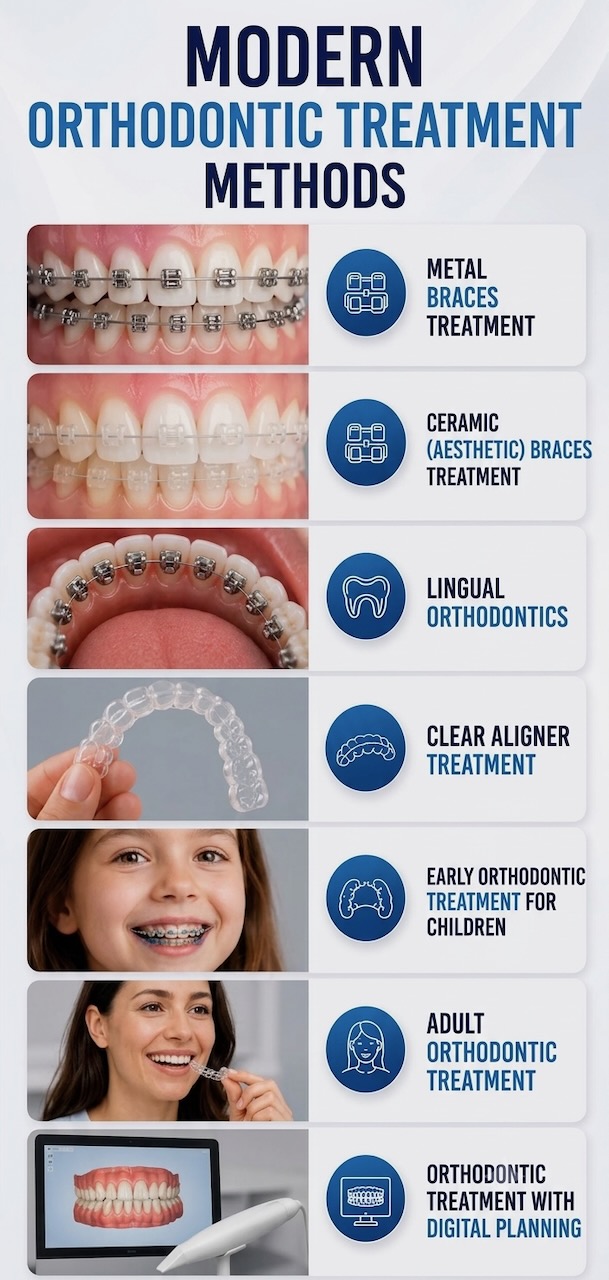
metal bracket treatment
It is the traditional and most widely used system. Small metal pieces glued to the teeth with special adhesives are called brackets and the force of movement is transmitted to the teeth by means of arc wires passing through these brackets. It is at the highest level in terms of durability and gives precise results even in the most complex biomechanical cases. Modern metal brackets have much smaller, smooth and comfortable designs compared to previous years. Especially children and adolescents can make this process more fun by using colored ligature tires.
Ceramic (aesthetic) bracket treatment
It is an ideal option for adults and teenagers who do not like the metal appearance, looking for a more aesthetic alternative. Made from translucent or tooth-colored sapphire/ceramic materials, these brackets are almost completely camouflaged on the tooth surface. Thanks to its reflective features, it is very difficult to be noticed in social life. It should be noted that ceramic structures are slightly more sensitive than metal structures and have a higher risk of breaking when faced with hard foods. In our clinic, stain-resistant upper segment aesthetic materials are preferred.
lingual orthodontics
In this method, also known as invisible braces, the brackets and arc wires are placed on the back surface of the teeth, not on the front surface, but on the tongue side. From the outside, it is completely impossible to understand that there is any appliance in the mouth. It offers unique comfort for professionals, artists and models working especially in the prominent business lines. This system, which requires personalized laboratory processes, is produced as gold or chrome-cobalt alloy, accompanied by sensitive computer programs in the laboratory. In the first weeks, although there is a slight sensitivity in the tongue and temporary phonetic changes in speech, adaptation is achieved in a short time.
Transparent Plaque Treatment
This method, which has become popular as ‘wireless orthodontics’, is the pinnacle of computer-aided design (CAD/CAM) and 3D printer technologies. On the digital dimensions of the patient taken with the intraoral scanners, the motion simulation of the teeth is performed and a series of transparent plates suitable for this process (Clear Aligner) is produced. Plaques are removable; Being able to be removed while eating, brushing teeth or during an important presentation gives the patient unlimited freedom. These plaques, which should be worn for an average of 20-22 hours a day, are aesthetically flawless with their completely transparent structure. As Akdiş Clinic, we carry out digital planning processes with transparent record systems that have proven their age around the world.
Early Orthodontic Treatment in Children
Experts from the American Orthodontic Society (AAO) and our clinic recommend that the first orthodontic examination of children should be done not later than 7 years old. In this early period, while the milk teeth have not been completely shed, the examinations made prevent the major skeletal problems that may occur in the future. The development of the jaw bones is guided by using movable appliances, jaw expanders and functional devices. Early interventions may eliminate the need for future tooth extraction or surgically-supported treatments or significantly shorten the process.
Orthodontic treatment in adults
Age does not have a restrictive effect on orthodontic tooth movements. Even a 60-year-old individual whose periodontal tissues are healthy can be safely treated. Adult patients often prefer transparent plaques or lingual systems for aesthetic concerns. The most important parameter to be considered in adult treatments is whether skeletal jaw stenosis or lower/upper jaw incompatibility can be camouflaged only by tooth movement, due to the completion of growth and development. In border cases, orthognathic surgery combinations or special biomechanics with mini screw support are used.
Orthodontic treatment with digital planning
Digital orthodontics, one of the strongest aspects of our clinic, begins with the use of high-resolution intraoral (mouth) scanners instead of traditional measuring spoons and dough. In seconds, the 3D digital model of your mouth is transferred to the computer screen. Thanks to special software, you can watch as a simulation from the first day how your teeth will look after treatment. These digital data sets reduce the error margin to zero, allowing the brackets to be glued on the teeth in the most ideal position (indirect bonding) or to produce transparent plates with microns at the micron level.
How is orthodontic treatment done?
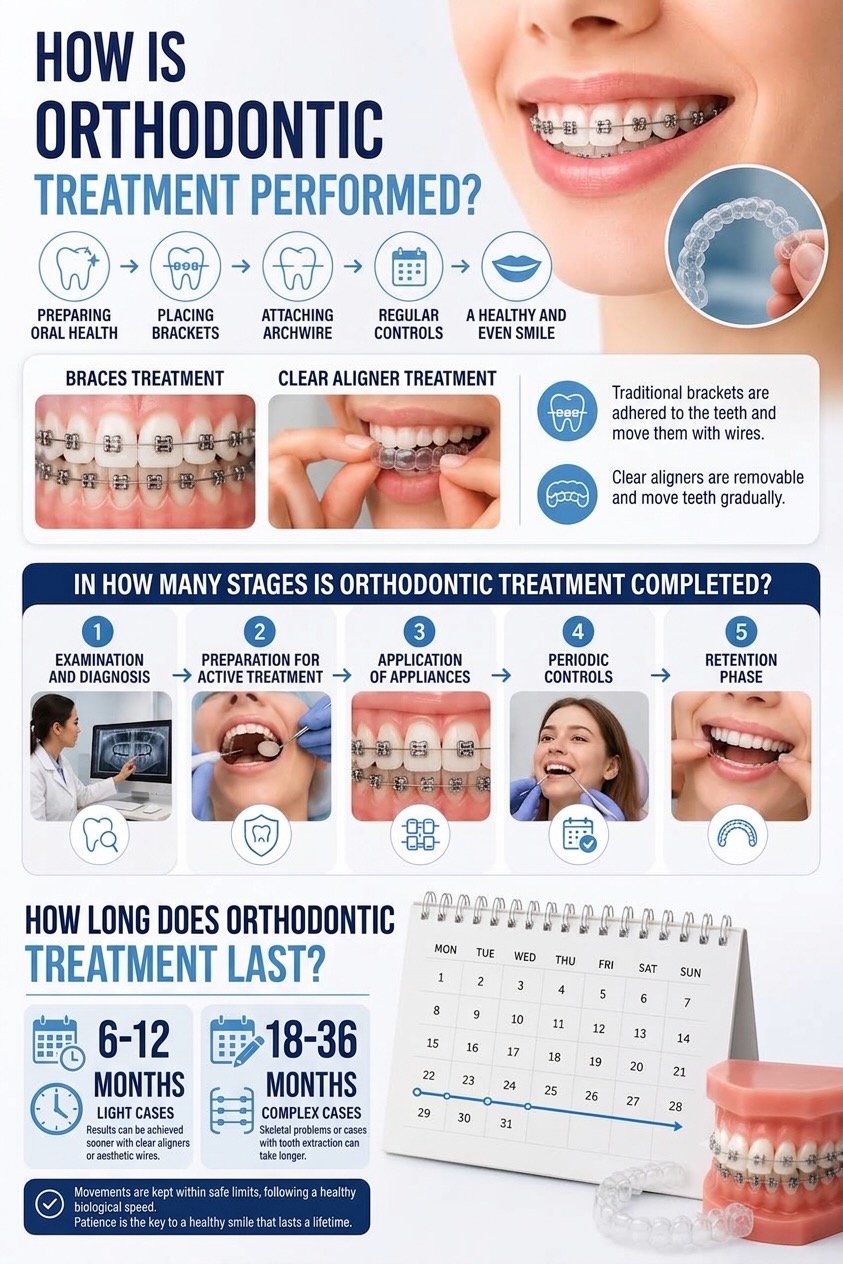
The treatment process consists of clinical sessions where scientific protocols are rigorously implemented. First of all, the patient’s existing oral caries, bleeding gums or tartar deposits are cleaned and the oral environment is made completely healthy. Then, according to the planned treatment model, the positioning of the brackets on the tooth surface is started. In traditional methods, tooth surfaces are smoothed with special solutions, then brackets are placed one by one with adhesive (adhesive) material and hardened with plasma light sources. Arc wires are passed through the grooves of these brackets and fixed with elastic or metal ligatures. In the treatment of transparent plaque, small composite protrusions called attachments are placed on the teeth and the first plate is delivered to the patient.
How many stages is orthodontic treatment completed?
A comprehensive orthodontic process is generally handled in 5 main stages:
- Inspection and diagnosis: The source of the problem (dental or skeletal mi) is determined by the analysis of digital scans, photographs and x-rays.
- Preparation for active treatment: Maximum oral hygiene, completion of filling and gum treatments, if any.
- Bonding Appliances: Installation of braces or delivery of the first set of transparent plaques.
- Periodic checks: Replacing the wires with sessions ranging from 4 to 6 weeks depending on the case, activations or plaque follow-up.
- Reinforcement period: After the teeth reach the targeted position, the appliances are removed and protective retainers systems are applied to prevent return.
How long does orthodontic treatment take?
The process varies widely depending on the degree of malocclusion of the patient, the rate of biological response of the jawbone, the age of the patient and the compatibility of the patient with the treatment. Mild crowdings or intermittent tooth formations can be resolved in short periods of 6 to 12 months with transparent plaques or aesthetic wires, while severe skeletal incompatibility, cases where buried teeth should be included in the arc, or complex planning with tooth extraction It can take between 18 and 36 months. It should not be forgotten that it is a medical necessity to move the teeth at physiological speeds that will not cause root absorption (resorption) without exceeding the safe limits in the bone. Every moment of this process that requires patience is the investment of a healthy smile that will be carried for a lifetime in the future.
Orthodontic treatment prices
The costs of orthodontic interventions cannot be subjected to a static pricing policy. Prices include the type of malocclusion in the patient’s mouth, whether to apply a single jaw or double jaw, the selected material (metal, ceramic, lingual, transparent plaque), additional appliances to be used (mini screws, jaw expanders) and completely personalized according to the prescribed duration of the treatment. shaped as. Although the Ministry of Health and the Turkish Dental Association (TDB) publish a base price tariff every year, the technological infrastructure of the clinic and the physician’s specialty degree determine the final budget.
Orthodontic Treatment Price Chart in Our Clinic
The table below shows the initial prices and clinical descriptions of the orthodontic treatments and related ancillary services applied within the AKDİŞ Clinic. Your final cost analysis will be revealed as a result of clinical examination and radiological evaluations.
| Treatment / Service Name | Clinical Description | Starting Price (TL) | Dependent factors and important notes |
|---|---|---|---|
| Metal bracket treatment (single jaw) | Alignment with conventional, high-strength metal systems. | 35,000 TL | It depends on the complexity of the case and the number of sessions. |
| Metal bracket treatment (double jaw) | Removal of all dental crooks in both the lower and upper jaw. | 60,000 TL | It is the most economical and effective solution for standard cases. |
| Ceramic Aesthetic Bracket (double chin) | Aesthetic material in tooth color, translucent sapphire or porcelain. | 75,000 TL | Optimized for material quality and staining resistance. |
| lingual orthodontic (double jaw) | Wires that are invisible from the outside, applied to the back (inner) surface of the teeth. | 110.000 TL | It requires personalized laboratory production and high precision. |
| Transparent plaque treatment (light cases) | Short-term wire-free treatment with Invisalign or Clear Aligner systems. | 55,000 TL | The number of plaques and laboratory costs are directly dependent. |
| Transparent plaque treatment (advanced cases) | Extensive plaque series requiring multidimensional motion and rotation. | 85,000 TL | International Distributor and Material Indexed Pricing. |
| Children’s early appliance treatment | Movable or fixed jaw appliances that drive growth. | 25,000 TL | It depends on the discipline of the child to wear the apparatus and the structure of the jaw. |
| Retainer app (single jaw) | Fixed or movable protector that maintains the position of the teeth at the end of the treatment. | 5,000 TL | It is the insurance of long-term success, it is mandatory. |
| Tooth extraction for orthodontics | Surgical ingestion to make room for the arc in cases with space stenosis. | 2,500 TL | price per tooth. It may vary locally, depending on the root anatomy. |
| Panoramic and cephalometric x-ray | Digital cephalometric graphics taken for diagnostic purposes before treatment. | 1,500 TL | This fee is not charged to our patients who start treatment in our clinic. |
Frequently Asked Questions (FAQ)