

What is smile design?
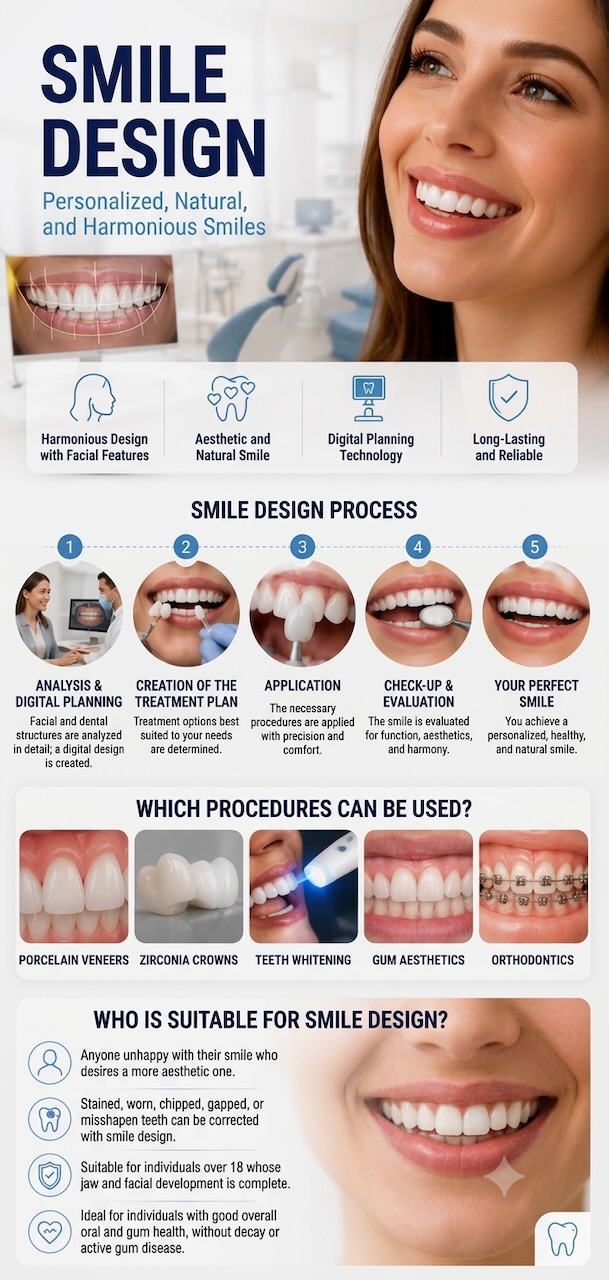
In today’s modern dentistry, having an aesthetic and harmonious smile as well as having a healthy mouth structure is among the top priorities of our patients.. smile designIt is the process of planning a completely personalized and natural smile, where the art of dentistry and advanced technology come together, the most suitable for the patient’s facial features, dental structure, lip symmetry and personal expectations. This treatment is not only an aesthetic touch, but also a comprehensive oral rehabilitation where chewing functions and phonetics (speech quality) are also improved.
AKDIŞ CLINIC As a result, we carry out this design process, in which the teeth, gingiva, lips and face are completely compatible, with the most up-to-date digital technologies and biologically compatible materials.
This concept, which requires a multidisciplinary approach, Cosmetic dentistry (Cosmetic Dentistry) is one of the most popular and transformative treatments in the field. The process of correcting the crowds, discolorations, tooth loss or gingival asymmetries in the patient’s existing tooth sequence using various aesthetic dentistry procedures is called the smile design.
This process is not just a single process. A combined treatment in which many different methods such as zirconium coatings, e-max laminate veneers, gingival aesthetics (gingivectomy/gingivoplasty), teeth whitening and orthodontic treatments are used together or in order according to the needs of the patient. protocol. Our aim is to create the “ideal smile” that is most suitable for the age, gender and facial anatomy of the patient, away from the artificial appearance.
Who is the smile design suitable for?
Aesthetically and functionally, every individual who is 18 years old and whose jaw-face development is complete is a potential candidate for this treatment. However, the patient’s general oral and gingival health must be of a certain standard to achieve a successful treatment result. In patients with active gum disease or caries, these basic health problems should be treated before aesthetic procedures.
Smile design treatment is frequently preferred by people who want to show a more self-confident stance in their social life or career, who feel the need to hide their lips while laughing, or who experience wear/color change in their teeth due to ageing.
In which situations is smile design preferred?
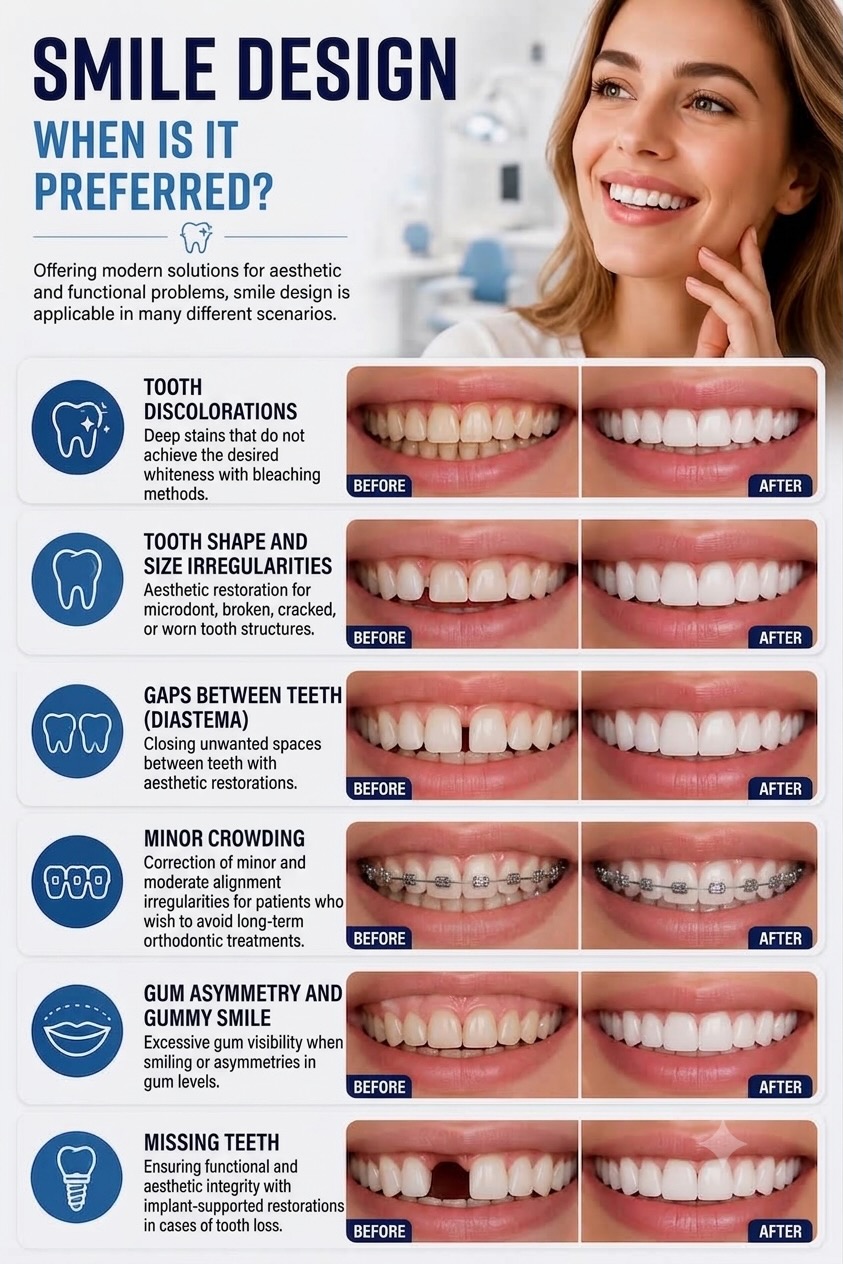
Aesthetic dentistry applications are planned not only to have whiter teeth, but also to solve many functional and structural problems. Smile design procedures are implemented in the following situations:
-
Tooth coloring: Deep discoloration caused by antibiotics, fluorosis or canal treatment, which cannot be achieved with traditional teeth whitening methods.
-
Dental Form and Size Disorders: Mikroti (smaller teeth), restoration of fractures, cracks or worn out teeth.
-
Interdental spaces (diastema): Closure of unwanted gaps between the teeth with aesthetic restorations without the need for orthodontic treatment.
-
Slight intricacies: Correction of mild and moderate sequencing disorders with veneer or veneers in patients who do not prefer long-lasting wire treatments (orthodontics).
-
Gingival asymmetry and gummy smile: When the gums appear more than normal when laughing (Gummy Smile) or asymmetries in the gum levels.
-
Missing teeth: Ensuring integrity with implant-supported restorations in cases of tooth loss.
Modern smile design methods
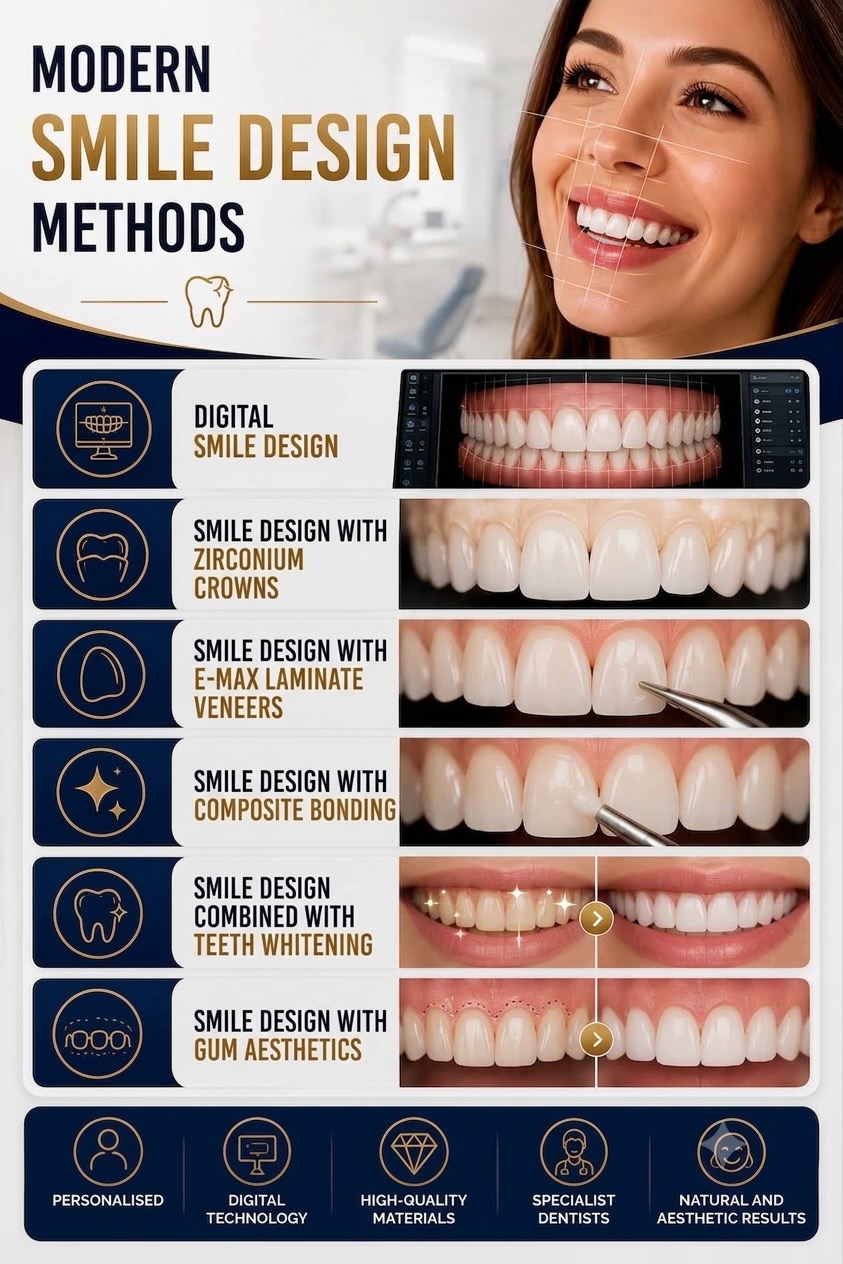
In a successful treatment planning, only one method can be selected according to the needs of the patient, as well as hybrid approaches in which more than one technique is combined. Here are the world-class modern methods we apply in our clinic:
Digital Smile Design (DSD)
It is a revolutionary protocol that allows us to show the patient how the result will be before starting the treatment, in the virtual environment or through intraoral rehearsals. The patient’s measurements are taken with intraoral digital scanners and face photos/videos are taken. Using special software, the most suitable tooth form, length and color are designed according to the golden ratio rules. In this way, the patient can predict the result to be obtained before the treatment process is started and can make changes on the design with the physician.
Smile design with zirconium coating
Known for its durability and biological compatibility, zirconium is an excellent option, especially in posterior teeth and anterior tooth restorations where tissue loss is high. Unlike traditional metal-supported porcelain, Zirconium Dioxide Thanks to its infrastructure, it does not cause bruising or gray reflection on the gums. Thanks to its light transmittance, it offers an aesthetic very close to the natural tooth, while it is also extremely resistant to high chewing forces.
Smile design with E-Max Laminate Veneer
E-max (lithium disilicate) restorations, which are considered today’s gold standard in anterior dental aesthetics, give results that are indistinguishable from real tooth enamel thanks to their extraordinary light transmittance. They are thin porcelain leaves (leaf porcelain) prepared only from the front surface of the tooth with a minimum (0.3 – 0.5 mm) or sometimes without any abrasion. We often prefer this method in our patients with maximum aesthetic expectations.. lithium disilicate Its material is texture-friendly and its color stability is very high.
Smile design with composite bonding
It is the process of layer by layer processing of aesthetic composite resins (filling-based aesthetic application) without any etching from the tooth surface. Ideal for closure of interdental spaces, repairing small fractures or extending tooth lengths. Although it is a more economical and faster solution than porcelain applications, the risk of discoloration due to the use of coffee, tea or cigarettes over time is higher than porcelains and may require periodic polishing.
Smile design combined with teeth whitening
If the patient’s current tooth form and sequencing is ideal, but only complains of color tone, clinical type (Office Bleaching) alone Tooth Whitening The process may be sufficient. In addition, if only the upper jaw is laminated veneer, the whitening process is often integrated into the smile design process to adapt the color of the teeth in the lower jaw to the newly made porcelain.
Smile design with gingival aesthetics
Only white and smooth teeth are not enough for a perfect smile; The health and symmetry of the pink tissue (Gum) surrounding the teeth is also critical. Pink aesthetics (Gingival contouring or Gingivoplasty) Asymmetric or too much (Gummy Smile) gums that have level differences with the process are shaped in millimeters with laser or electrosurgical devices. Thus, the golden ratio between the tooth and the gum is provided.
I completed the first part of the article (definitions, compliance, indications and methods) here. second part Treatment stages, duration, material selection, mock-up simulations, Hollywood smile difference and the special css design you mentioned price tables and Turkey price comparisons I will build.
How is the smile design done?
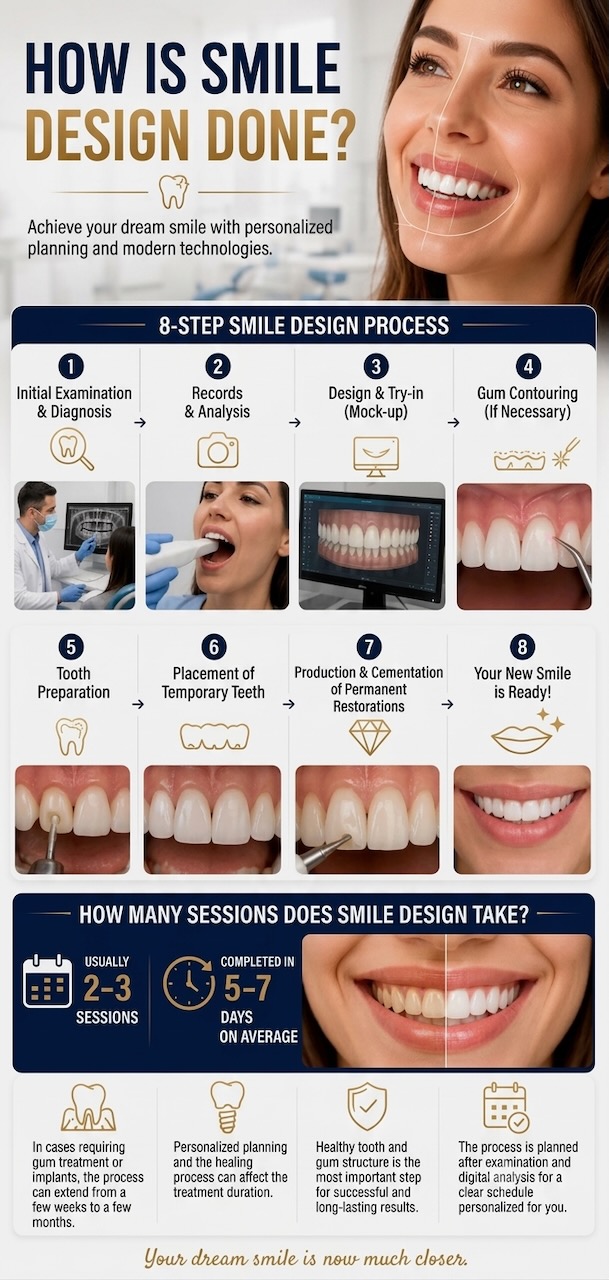
a comprehensive smile design Usually it includes the following steps:
-
Initial examination and diagnosis: Existing dental and gum health is evaluated. Root and bone structure is examined with panoramic x-ray and 3D tomography (if necessary). If there are caries, root canal treatment needs or gum diseases, they are treated first.
-
Registration and analysis: Digital measurements are taken and photographs are taken with intraoral scanners.
-
Design and Rehearsal (Mock-up): The digitally prepared design is rehearsed in the patient’s mouth.
-
Gingival shaping (if necessary): If pink aesthetics is needed, the gingival levels are regulated with laser and the healing process is expected.
-
Preparation of teeth (preparation): According to the preferred method (Zirconium or E-Max Laminate Veneer), a minimal roughening or thinning is performed on the tooth surface. In some cases (composite bonding or prepless veneer) no substance can be removed from the tooth.
-
Attaching temporary teeth: Temporary coatings are attached immediately after the teeth are prepared. Thus, the patient continues his daily life without any aesthetic or functional loss.
-
Production and cementation of permanent restorations: Permanent porcelain is produced by specialist ceramists in the laboratory. The last rehearsed porcelain is integrated into the teeth with special medical adhesives.
How many sessions does the smile design complete and how long does it last?
There is no definite answer to this question because time; It may vary depending on the patient’s teeth, gums and facial structure.. However, a standard smile design usually 2 to 3 sessions lasts and average 5 to 7 days is completed in it.
If the patient needs gingival treatment (eg Gummy Smile surgery) or implant-supported restoration, this period can be extended from a few weeks to several months due to the healing process of the tissues. Clear calendar of the process, FROM OUR CONTACT PAGE It will become clear after the examination and digital analysis you will make by making an appointment.
Frequently Asked Questions (FAQ)
AKDIŞ CLINIC As a result, we see the smile design process not only as covering teeth, but as an artistic and medical rehabilitation.
With our specialist physician staff, 3D scanners and digital smile simulation software, we show you the result before the treatment. We ensure your health by using the best quality, FDA-approved biological materials (Ivoclar E-Max, Premium Zirconium Blocks). To create the most suitable treatment plan for you and recreate your smile communication You can create a detailed examination appointment by contacting us on our page.
No, it is not a painful procedure. If any preparation (cutting) or gingival shaping will be made on the teeth, local anesthesia is applied to the relevant area before the procedure. After the procedure, there may be a temporary pain or cold/hot sensitivity, but this situation is easily controlled with simple painkillers.
A comprehensive smile design usually takes 2 to 3 sessions. This process is completed in an average of 5 to 7 days. However, if the patient needs gingival treatment or surgical procedures such as dental implants, this period may be extended. The duration becomes clear after examination and digital analysis.
Smile Design Prices; It varies according to the type of material to be used (e-max, zirconium, composite), the number of teeth to be included in the process and additional treatment needs such as gingival aesthetics. Final pricing is determined only after the clinical examination with a personalized treatment plan.
The average lifespan of zirconium and e-max restorations is between 10 and 15 years in patients who provide regular oral hygiene, use interface brushes and do not disrupt routine 6-month dental check-ups. At the end of this period, restorations may need to be renewed due to polish or loss of fit.
Aesthetically, E-Max (lithium disilicate) porcelains, thanks to their high light transmittance, offer the closest and most natural appearance to natural tooth enamel. Zirconium, on the other hand, is aesthetic, but is more durable and opaque compared to E-Max, so it is generally preferred to cover the teeth of the posterior region or to cover the teeth that have become very dark in color.
It depends on the patient’s current tooth structure and the chosen method. No matter can be removed from the tooth in composite bonding and “preless” veneer applications. However, for E-Max laminate, a slight roughening of 0.3-0.5 mm from the front surface of the tooth is required, and for zirconium coating, a reduction of 1-1.5 mm is required from around the tooth.
Although the two terms are often used interchangeably, the smile design is a concept that is more natural, where personal asymmetries can be preserved and aims at maximum compatibility with the face. Hollywood Smile, on the other hand, is a more standard, ostentatious and comprehensive jaw restoration, where very bright white colors are used, where teeth are completely symmetrical and prominent.
If the patient’s gums appear too much (Gummy Smile) or if there is asymmetry in the gum levels, gingival aesthetics (gingivectomy/gingivoplasty) are included in the smile design planning to achieve a perfect result.