

What is Root Canal Treatment?
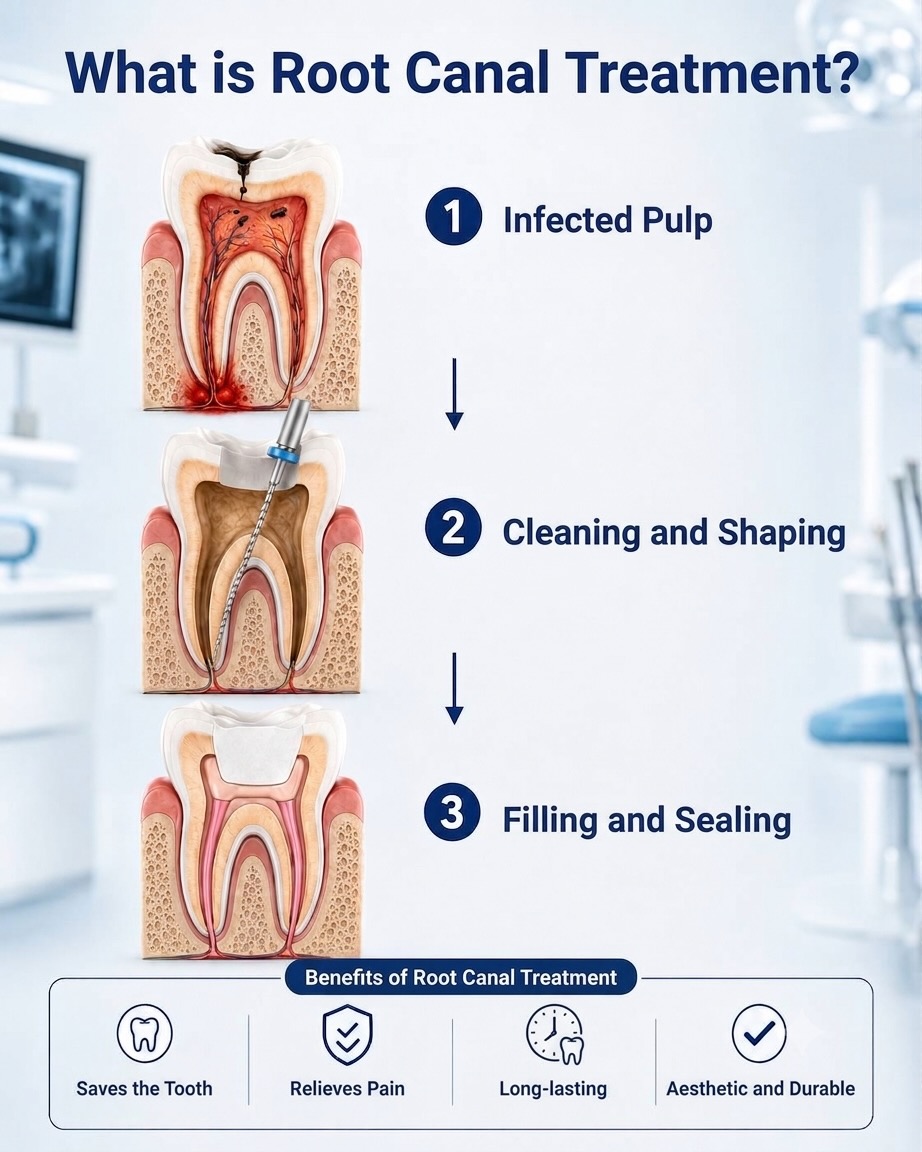
Root canal treatment, in the medical literature endodontics It is one of the most basic and critical treatment methods of the department known as This treatment can be sterilized by sterilizing the inflamed, infected, or lost tooth pulp (tissue in the center of the tooth, in the center of the tooth) for various reasons. is the process of filling.
The enamel that forms the outer layer of the tooth and the dentin tissue just below it preserves the delicate living structure inside. However, when these protective layers are overcome due to deep caries, hard blows to the tooth, chronic microtrauma or gum disease, bacteria pulp reaches his room. Bacteria that reach the pulp chamber initiate a rapid inflammation process. Since the tooth canals are like a closed box, edema and gas caused by inflammatory reactions cause severe pressure on the dental nerves. Root canal treatment, at this stage, both relieves the patient’s severe pain and saves the tooth from being pulled, enabling it to maintain its place in the jawbone.
In which cases is root canal treatment necessary?
The need for a tooth canal treatment indicates that the network of nerves and vascular networks inside the tooth is unprotectedly damaged. The main clinical conditions requiring endodontic intervention are:
- Deep bruises: Rotten tissues, which exceed the filling limits and progress to the core of the tooth, require root canal treatment.
- Dental traumas: Fractures in the tooth as a result of an accident, fall or impact can reveal the nerve group or cut the blood flow and cause the tooth to die from the inside.
- Irreversible Pulpitis: Severe states of severe inflammation that the nervous tissue cannot heal itself.
- Dental abscesses and cysts: When the inflammation accumulated at the end of the tooth root begins to dissolve the surrounding bone tissue, it is necessary to clean the root canals.
- Prosthetic reasons: The state of opening the pulp chamber during the reduction of excessively curved or positioned teeth for bridge or crown restorations.
Modern root canal treatment methods
With the development of technology, there have been revolutionary innovations in the field of endodontics.. AKDIŞ CLINIC As a result, we maximize the success rate by using world-class equipment and materials.
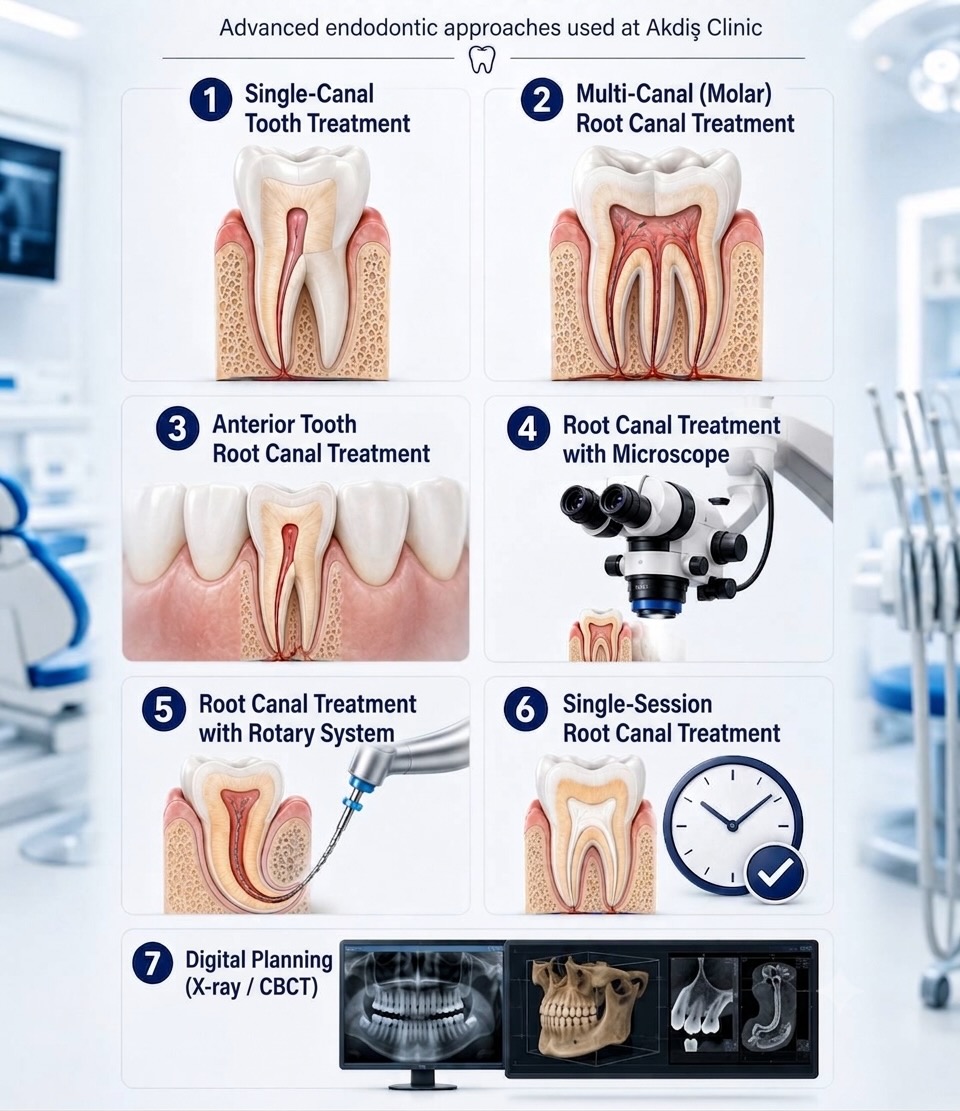
Single-channel dental treatment
The incisors and some molars, which are usually located in the anterior region of the mouth, have a single-rooted and single-channel anatomy. Single-channel dental treatment usually takes shorter due to less anatomical complexity and can be safely completed in a single session if there is no acute infection.
Multi-channel (molar) root canal treatment
Molars can usually have 3, 4 and sometimes even more ducts. These canals can exhibit a rather narrow, curved and branched structure. Multi-channel treatment applications require a high level of expertise, patience and use of precision equipment. The absence of microscopic anatomical variations is critical for the longevity of the treatment.
anterior dental canal treatment
Since the anterior teeth are located in the aesthetic area, it is of great importance to preserve the natural color of the tooth during and after the treatment. The drugs and filling materials used in the anterior tooth canal treatment process should be selected from modern materials that do not cause discoloration (graying or yellowing) in the tooth tissue.
Root canal treatment with microscope
Root canal treatment under the microscope, also called microendodontia, allows us to detect extra channels, microscopic cracks and intra-canal anatomical irregularities that are impossible to be seen with the naked eye or magnifier by traditional methods. Thanks to the operation microscopy, the physician will enlarge the treatment area up to 25 times, obtaining an excellent field of view and minimizing the margin of error.
Canal treatment with Rotary System
Rotary instrument systems (Rotary System) produced from nickel-titanium (Ni-Ti) alloys are used instead of traditional hand files. These flexible files move confidently to the root tip without disturbing the form of the curved channels. Canal treatment with Rotary System shortens the procedure time, increases patient comfort and provides much more homogeneous cleaning of the canal.
Canal treatment in one session
If an active abscess in the tooth does not have acute fistula or intense root tip infection, treatment can be completed in a single session in cases where the pulp is alive. Thanks to our advanced disinfection techniques, duct cleaning, shaping and permanent filling are made within the same day and the time spent by the patient in the clinic is reduced.
Canal Treatment with Digital Planning (X-ray/CBCT)
In addition to two-dimensional digital x-rays (RVG) before treatment, we use three-dimensional dental tomography (CBCT) technology in complex cases. Thanks to digital planning, the length, slope and relationship of the root canals are analyzed in millimeters.
How is root canal treatment done?
A modern and painless root canal treatment process applied in the Akdiş clinic consists of the following stages:
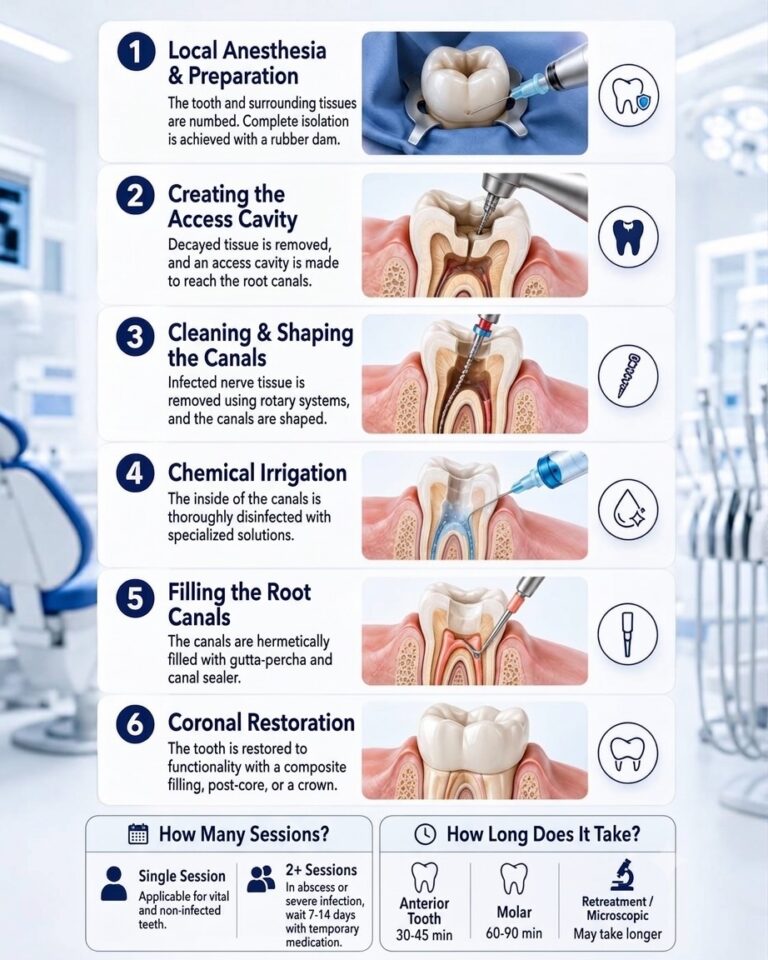
- Local anesthesia and preparation: Tooth and peripheral tissues to be treated local anesthesia completely numbed by the method. The patient does not feel any pain during the treatment. Then the tooth is completely isolated from saliva and oral bacteria using a rubber dam (rubber cover).
- Creating the input cavity: The decayed tissues in the tooth are cleaned and a suitable entrance hole (cavity) is opened to reach the root canals.
- Cleaning and shaping of ducts: Infected nerve tissues in the root canals are meticulously removed with the help of rotary systems. Channels are expanded in a suitable form up to the root tip.
- Chemical irrigation: In addition to mechanical cleaning, special washing solutions (sodium hypochlorite, EDTA, etc.) are introduced into the ducts, and bacteria in the side channels that mechanical tools cannot reach are completely destroyed.
- Filling root canals: Cleaned and dried ducts, to ensure sealing Gutta-Perka It is tightly filled up to the root tip with a natural, biocompatible substance called and special canals.
- Upper restoration: After the canal filling is finished, the tooth is made functional by composite filling, post-core or crown restoration according to the material loss of the tooth.
How many sessions can root canal treatment be completed?
How many sessions the root canal treatment will be completed depends entirely on the condition of the tooth. Treatment of non-infected teeth with live nerves can be successfully completed in a single session. However, if there is an abscess, intense inflammation of the tooth or bone destruction in the root of the tooth, special calcium hydroxide-based temporary drugs are placed inside the ducts and the determined period (7-14 days) is expected. In such complicated cases, treatment may take 2 or more sessions.
How long does root canal treatment take?
Processing time varies according to the anatomy of the tooth and the number of channels. Usually, treatment for single-channel front teeth takes an average of 30 to 45 minutes, while treatment of multi-channel and anatomy of molars can take between 60 and 90 minutes. In cases of microscopic applications or retreatment (renewal of canal therapy), this period may be extended a little more.
Why are the ingredients used in canal treatment important?
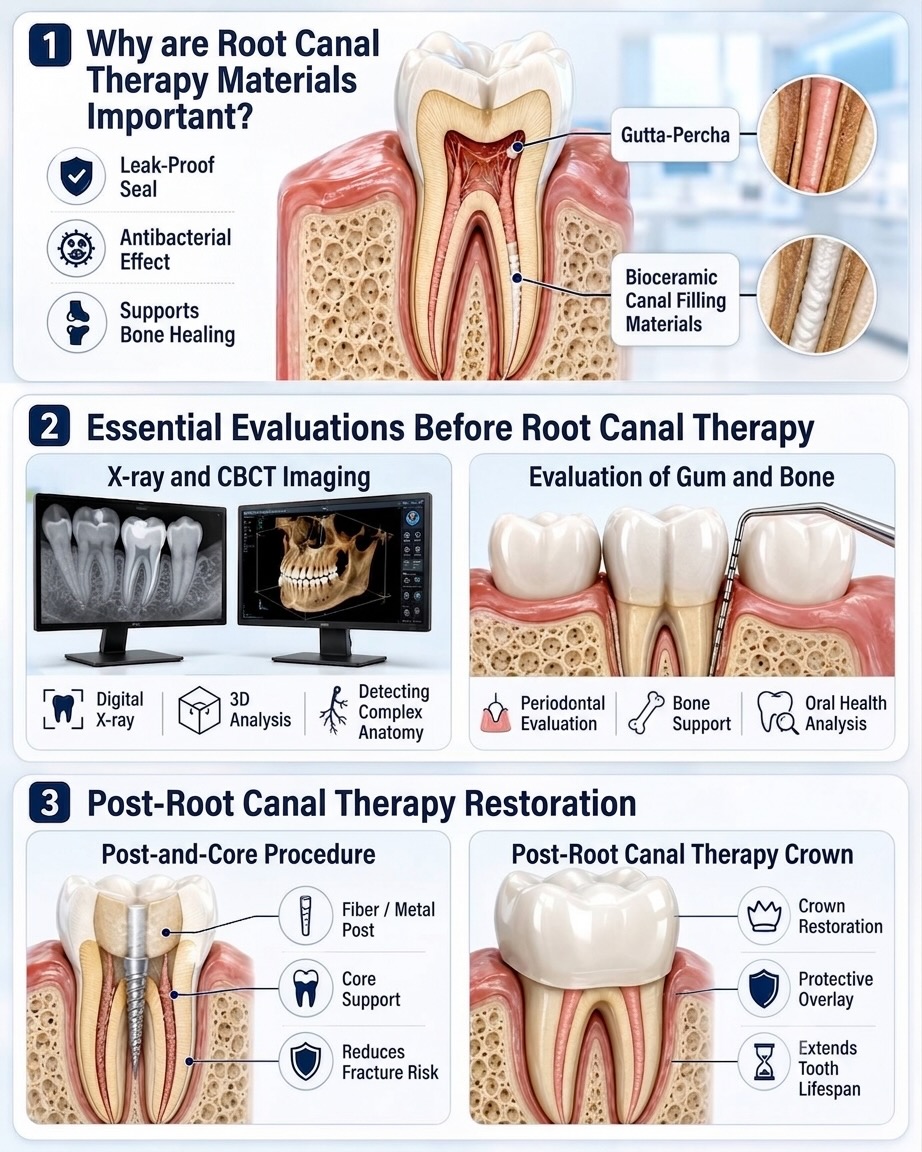
The long-term success of root canal treatment is directly related to the quality of the materials used. The gutta-percha substance, which is used to seal the root canals, should be tissue-friendly and should not shrink over time. Today, bioceramic-based canal fillers, which are used instead of traditional pastes, are chemically attached to the root canal walls, show high antibacterial properties, and accelerate bone healing at the root tip.
Required evaluations before root canal treatment
A successful endodontic treatment begins with an accurate diagnosis and a thorough planning process. Clinical examination alone is not sufficient.
X-ray and CBCT imaging
In our clinic, digital periapical x-rays are taken from each patient before treatment. If the root tip lesion is very large, if there is a suspicion of calcification (occlusion) in the ducts, or if the anatomical variations are complex, 3D examination is performed with conical beam computed tomography (CBCT). In this way, no anatomical details can be missed.
Evaluation of gums and bones
In order for a tooth to be saved by root canal treatment, the gingiva and the alveolar bone surrounding the tooth must have sufficient health. Since the success of root canal treatment may be limited in severe periodontal (gingival) destruction and swinging teeth, first of all, a versatile oral health evaluation is made.
Restoration after root canal treatment
A tooth that has been treated can become more brittle over time as it is deprived of nerve and vascular nutrition. In addition, there is a serious loss of substance in the tooth, as this treatment is usually needed due to a large caries. For this reason, it is vital to choose the right upper restoration correctly.
Post-core (Kor-post) app
If there are not enough walls to support the filling in the crown part of the tooth, a fiber or metal post (rod) is placed inside the root canal. This post provides support from the root, allowing the upper part to attach to the tooth and reduce the risk of tooth breakage.
Crown after root canal treatment
It is recommended to apply zirconium, e-max or porcelain crowns (plating) especially after root canal treatment for the molars in the posterior region, which are heavily exposed to chewing forces. Crown restoration protects the tooth like a helmet, protecting it against vertical and horizontal forces, prolonging the life of the tooth.
Frequently Asked Questions (FAQ)
Root canal treatment prices may vary in a wide range throughout Turkey and especially in health tourism centers such as Antalya and Istanbul. The main reasons for this are: the number of canals of the tooth (a single-channel tooth and the upper jaw 4-channel workmanship are not the same), the title and experience of the physician performing the treatment (endodontist specialist), the clinic in the clinic, the rotary instrument systems, the operation microscope or 3D tomography. Whether technologies are used or not and the quality of bioceramic filling materials preferred when closing the root canals.
It is vital for our patients to be cautious against the canal treatment offers, which are well below the market in general, at extraordinary cheapness. In cheap treatments, the chemical irrigation (washing time) of the ducts is generally kept insufficient in order to shorten the process time, and the hidden additional channels cannot be cleaned because the microscope is not used. In addition, repeated use of rotary files, which should be disposable, can lead to breakage. When poor quality canal popping and filling materials are used, a leakage occurs at the root end, resulting in severe pain, abscess formation and tooth loss in a short time.
A modern root canal treatment success with the right technique, expert staff and bioceramic materials is between 95% and 98%. A quality treatment preserves the biological integrity of the tooth in the jawbone and can keep the tooth in the mouth for life with a successful crown restoration. Compromising on quality in the treatment leads to reendodontic treatments (channel regeneration) that are much more costly and painful in the future, apical resection surgeries or the obligation to implant instead of the tooth. Losing your teeth incurs much higher costs than a quality canal treatment to be done at the beginning.
The basic philosophy of our clinic is based on “protective dentistry”. Even if the chance of a tooth to be saved is 1%, the priority is always to keep that tooth in the mouth with root canal treatment. Tooth extraction, but if there is a vertical full layer of fracture in the root of the tooth, is the last resort preferred if the caries tissue has decreased far below the bone level. When a tooth is left empty, the chewing balance is disturbed; An implant treatment to fill this gap requires much longer time and budget.
As Akdiş Clinic, we closely follow the latest scientific developments and digital technologies in the field of endodontics. With our expert staff, we offer a completely painless, reliable and comfortable treatment process with advanced operation microscopes and rotary tool systems, without compromising the rules of sterilization. Our aim is to ensure that you smile with health for many years by treating your teeth to the highest quality standards.