

What Is Teeth Whitening?
Teeth whitening, the outermost layer of the teeth is enamel (enamel) and organic and inorganic colored molecules that have penetrated the dentin below it, using specially formulated whitening gels (usually hydrogen peroxide or carbamide peroxide-based agents) It is the process of breaking down with the oxidation reaction and opening the tooth color several tones compared to the natural tooth color of the person.
This process, which is often confused with “tooth calculus cleaning (detertral)” is not the mechanical scraping of the plaques and tartars on the tooth surface; It is the bleaching of color pigments in the tooth’s own internal tissue (intrinsic) by a chemical process. Therefore, it does not only provide a superficial cleansing; It goes beyond the main color of the tooth genetically, offering an aesthetically satisfying shine. It is an extremely reliable, risk-free and minimally invasive aesthetic dentistry practice when applied under the control of the dentist, at the right concentrations and with the help of personal protective protocols.
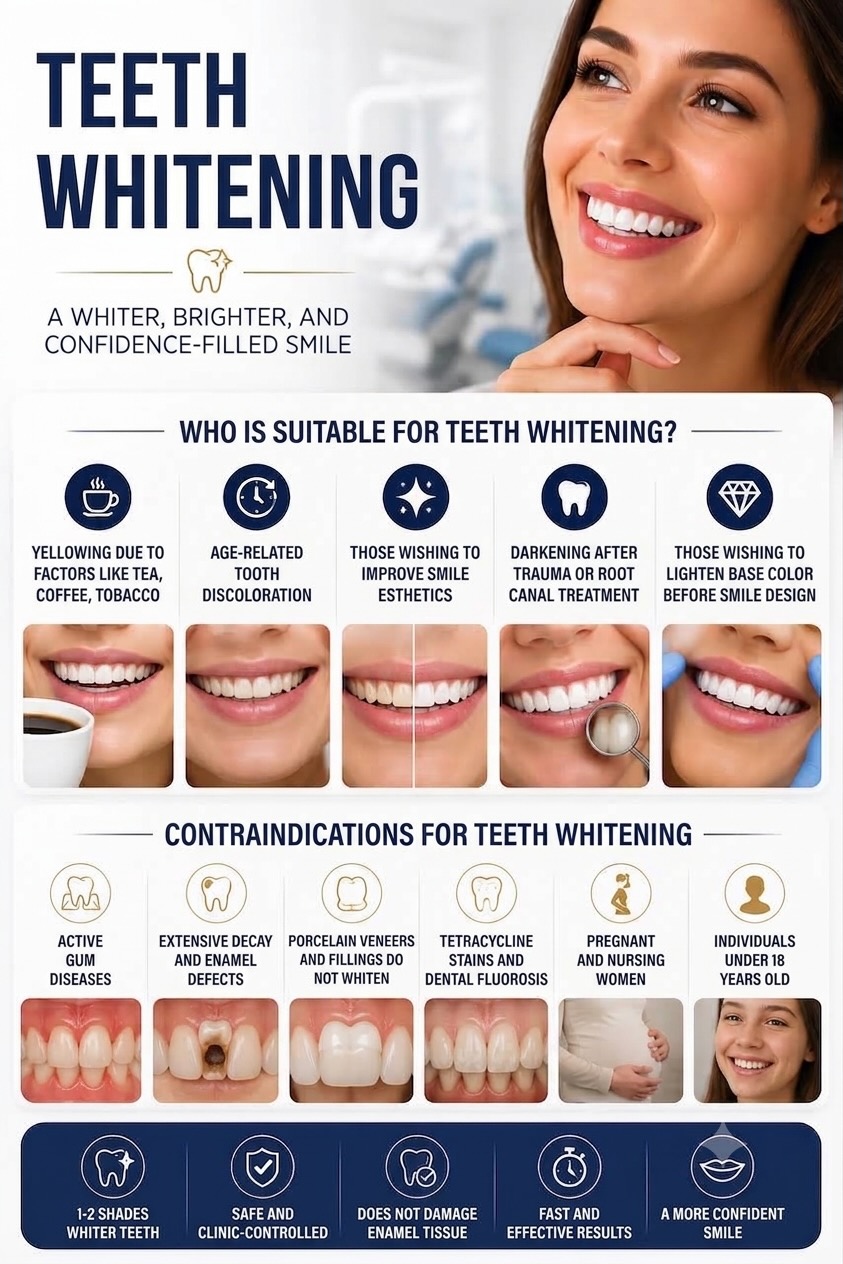
Who is teeth whitening suitable for?
Professional teeth whitening is an ideal treatment for adults with healthy teeth and gums who want to have a more aesthetic and luminous smile. However, as in every medical procedure, the success rate of the bleaching procedure differs according to the patient’s current oral condition.
Ideal candidates for teeth whitening:
-
Those who have yellowing due to external (extrinsic) factors such as the use of tea, coffee, red wine, tobacco products (cigarettes, cigars) in their teeth.
-
Individuals whose teeth darken due to the thinning of the enamel layer and the clarification of the lower yellowish dentin layer due to aging.
-
who want to improve smile aesthetics and smile design Those who want to lighten the ground color of their teeth before starting the (Hollywood smile) process.
-
Those who have darkening (color loss) problems in a single tooth after previous traumas or root canal treatment (endodontic treatment).
Situations where teeth whitening cannot be applied or limited benefits are:
-
Active gum diseases: In patients with gingivitis or periodontitis, gingival treatment should be completed before bleaching.
-
Wide bruises and enamel defects: In people with untreated teeth or enamel cracks in their teeth, the whitening gel may reach the inner parts of the tooth, causing severe pain and nerve damage.
-
Porcelain coatings and fillings: Whitening gels are only effective on natural tooth tissue. Zirconium coating, porcelain laminated, composite or amalgam fillings do not whiten with this process. These restorations, which are made according to the current tooth color, may appear incompatible, lagging behind the color after the teeth are whitened. (In this case, refurbishment of existing coatings may be required).
-
Advanced tetracycline spots and dental fluorosis: Dental fluorosis spots caused by excessive fluoride exposure in childhood or deep gray-blue discolorations caused by tetracycline group antibiotics used during pregnancy/childhood may not be completely relieved by standard bleaching. In these cases, personalized porcelain laminate or zirconium coating treatments are recommended in our clinic.
-
Pregnant and lactating women: Since there are not enough clinical studies on the effects of whitening agents on the fetus or baby, bleaching is not recommended medically during these periods.
-
Individuals under 18 years old: The pulp (dental nerve) chamber is larger at young ages. Since the enamel layer may not have fully completed its development, there is a risk of severe sensitivity.
What causes discoloration in the teeth?
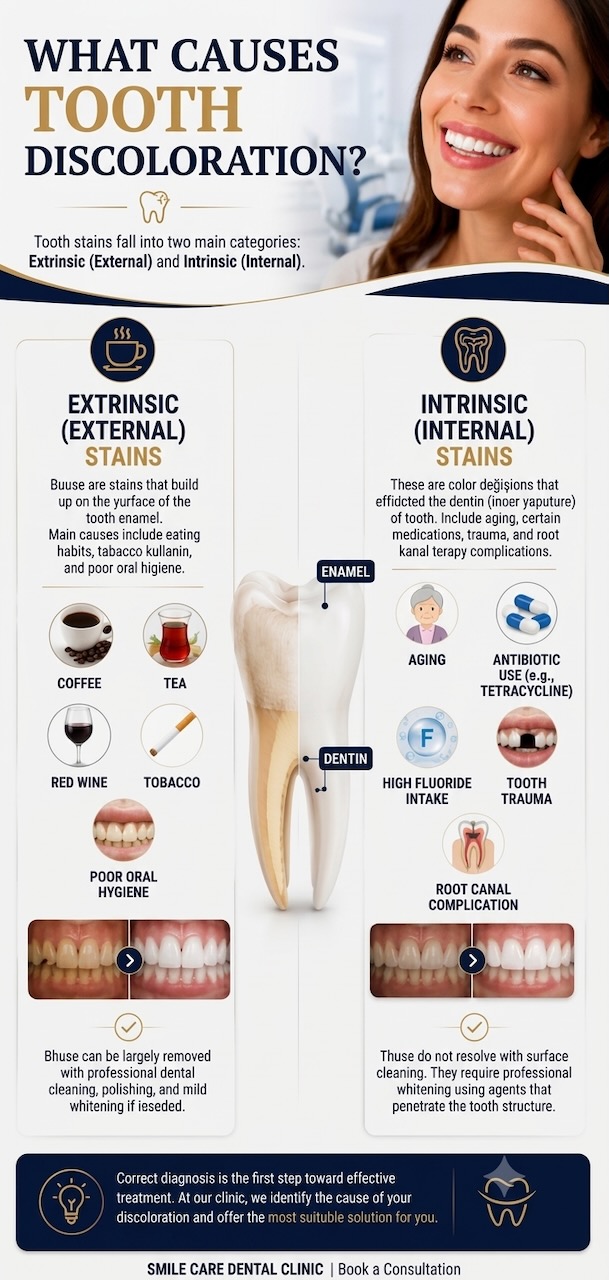
To understand the treatment process, first of all, it is necessary to know why the teeth change color. Tooth coloring is clinically divided into two main categories:
-
External (extrinsic) discolorations: They are spots that accumulate on the enamel layer, which is the outermost surface of the tooth. Consumption habits (densely pigmented foods such as coffee, tea, cola, red wine, soy sauce, curry), use of tobacco products and insufficient oral hygiene are the main causes. Usually regular calculus cleaning And it can be largely eliminated with polishing processes, while the remaining pigmentation can be completely destroyed by a light whitening process.
-
Intrinsic (intrinsic) discolorations: They are color changes that have penetrated into the dentin tissue, the deeper layer of the tooth. Aging, febrile diseases in childhood, antibiotic use such as tetracycline, high fluoride intake, dental traumas or canal treatment complications lead to this situation. Such discolorations do not go away with superficial cleaning, they require professional teeth whitening with peroxide-based agents penetrating into the tooth tissue.
Modern teeth whitening methods
There are different professional teeth whitening methods that can be preferred according to your aesthetic expectations, current tooth color, budget and tooth sensitivity. As AK Dental Clinic, we apply FDA and CE approved, reliable and effective systems that are accepted by world standards. Modern teeth whitening (bleaching) methods are generally grouped under the following headings:
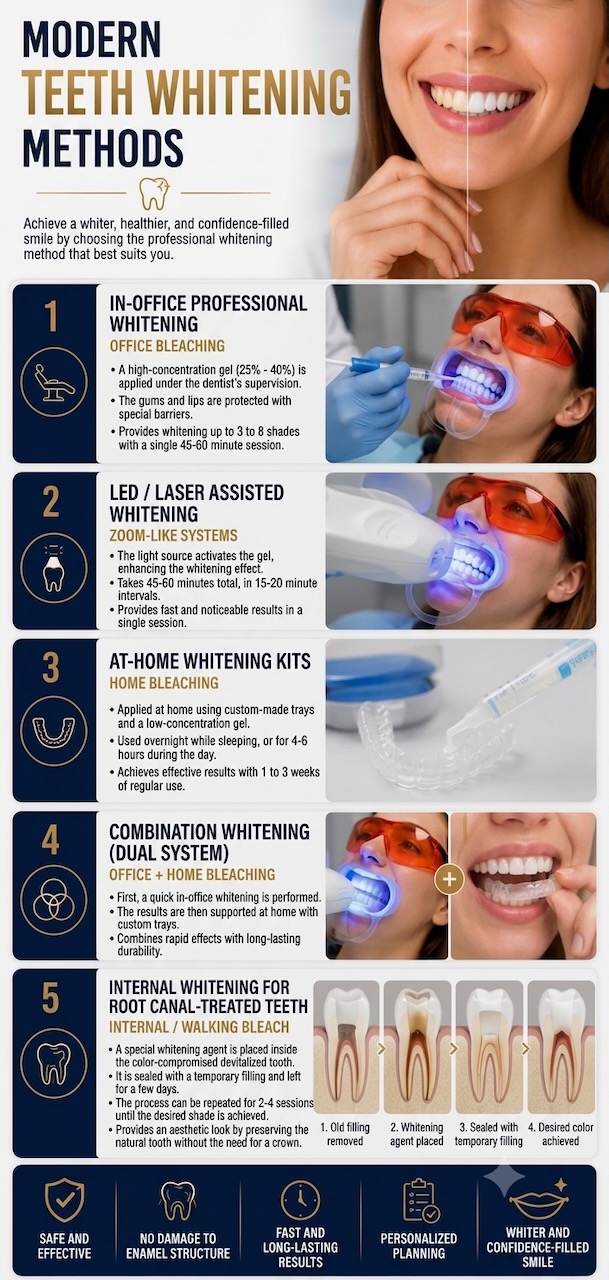
1. Professional whitening (office type) in the clinic (Office Bleaching)
Office Type Whitening, is the fastest, most effective and most reliable teeth whitening method applied directly by our dentist in our clinic. In this method, also known as “Laser Teeth Whitening” or “Light Whitening”, high concentration (25% – 40%) hydrogen peroxide gels are used only suitable for professional clinical use.
How is it applied? First of all, the patient’s lips and gums are meticulously isolated using special barriers and retractors (retractors). This stage is extremely critical; Because the contact of high concentration bleaching agents to soft tissues (gums, cheeks, tongue) can cause chemical irritation or temporary tissue burns. After isolation, whitening gel is carefully applied to the surfaces of the teeth.
2. LED/Laser-assisted whitening (zoom-like systems)
In order to increase the effectiveness and speed of the office type application, a special LED, halogen or laser light (light source) is reflected on the gel applied to the teeth. This light quickly activates the active molecules in the gel, maximizing the oxygen release (oxidation) and allowing the color pigments to break down in a much shorter time.
-
Duration and Result: It is usually applied in a single session and a session takes a total of 45-60 minutes in periods of 15-20 minutes. At the end of a single session, the tooth color can be lightened up to 3 to 8 tons, depending on the person’s starting tone.
-
Advantage: It is the best solution for patients with time constraints and wanting a fast and distinct result (for example, before the wedding, before the special invitation). It is completely safe as it is done under the control of the dentist.
3. Home Bleaching Kits (Home Bleaching)
Home type whitening, is a system in which the patient applies the procedure at home under the guidance and control of the dentist. The active ingredient used in this method is usually carbamide peroxide or very low rate hydrogen peroxide with a lower concentration (10% – 22%). The slow release of the gel is to ensure safety in home use.
How is it applied? First of all, your oral measurements (digital scanners or traditional materials) are taken in our clinic. Based on these measurements, only a thin, transparent and personalized measuring spoon (plak/tray) is prepared in the laboratory environment that fits perfectly into your tooth structure. You are usually asked to wear these records delivered to you during the night (or 4-6 hours a day) by squeezing the amount of whitening gel described by our physician.
-
Duration and Result: Reaching the desired whiteness usually requires regular use every day between 1 to 3 weeks, depending on the current coloring.
-
Advantage: Although the process progresses more slowly, it is very effective in the opening of the discolorations that penetrate the deep layers of the tooth and in the long-term permanence (stabilization) of the result. The risk of tooth sensitivity is slightly lower than the office type.
4. Combined whitening (dual system)
Combined bleaching, office type and home bleaching are used in an integrated manner “Golden Standard” is the method.
In the clinic, a single session (or two sessions) is made with high-power laser-supported office type whitening, resulting in a rapid and visible discoloration. Immediately after, specially prepared plaques and lower concentrations of household gels are given, and the clinical results are required to be supported and reinforced at home for 5 to 7 days.
-
Advantage: For teeth with severe yellowing or stubborn coloring (e.g. smokers) The deepest, smoothest and most lasting whiteness It is a guaranteed method. It is an excellent synthesis of rapid effect and long-lasting durability.
5. Internal whitening in root canal treatment (Internal / Walking Bleach)
Sometimes a single tooth is a blow (trauma) received in the past, or an applied root-stock As a result of (endodontic treatment), it may lose its vitality and turn gray, brown or blackish in time. Whitening gels applied to this tooth from the outside (office or household type) do not affect the outer surface of the tooth, but in the pulp chamber inside.
Interior whitening (internal bleaching) In the process, the pre-made filler is removed. After a special barrier that protects the root canal is placed inside the tooth, a special whitening agent (usually a mixture of sodium perborate or hydrogen peroxide) is placed directly in the inner cavity (cavity) of the tooth and temporary filling is made to the tooth.
-
Duration and Result: The patient waits for several days with this temporary filling (this condition is called “Walking Bleach”). This process can be repeated every few sessions (usually 2-4 sessions) until the desired tint is harmonized with neighboring teeth. When the desired color is obtained, the inside of the tooth is cleaned and the process is terminated by making a permanent composite filling.
-
Advantage: It is a life-saving treatment that provides aesthetic integrity by preserving the tooth’s own tissue without the need to make a coating (zirconium/laminated) in devital (inanimate) teeth with serious discoloration.
How is teeth whitening done?
The professional tooth whitening process carried out in the clinical environment is carried out step by step within the framework of certain protocols, taking into account the maximum patient comfort and safety. A standard office-type whitening session at AK Dental Clinic consists of the following stages:
-
Preliminary Inspection and Analysis: The dentist examines the mouth. If there is caries, gingivitis or tartar, these problems are treated first.
-
Color Detection (Shade Guide): The current color of the teeth before the procedure is determined and photographed using the standard color scale. This step provides a reference to measure the success achieved after the procedure.
-
Preventive preparation: Protective cream is applied to prevent damage to the lips. The retractor (retractor) is placed, which keeps the mouth open. In order to protect the gums from chemical agents, a special barrier that hardens with light to the border where the tooth and gingiva is carefully applied and frozen.
-
Application of the gel: High concentration of hydrogen peroxide gel is carefully applied only to the front surfaces of the teeth, with a thickness equal to it.
-
Activation (Light/Laser Application): A special LED or laser light is projected onto the applied gel to speed up the reaction. This process is usually performed in 15-20 minutes periods (cycles). If necessary, the old gel is deleted and a new one is applied and 2 or 3 cycles are repeated.
-
Cleaning and sensitivity remover: When the process is finished, the gel and protective barriers are cleaned. Special creams containing fluoride or potassium nitrate are applied to the surface of the tooth to prevent possible sensitivity and strengthen enamel.
Why is safety and correct application important in teeth whitening?
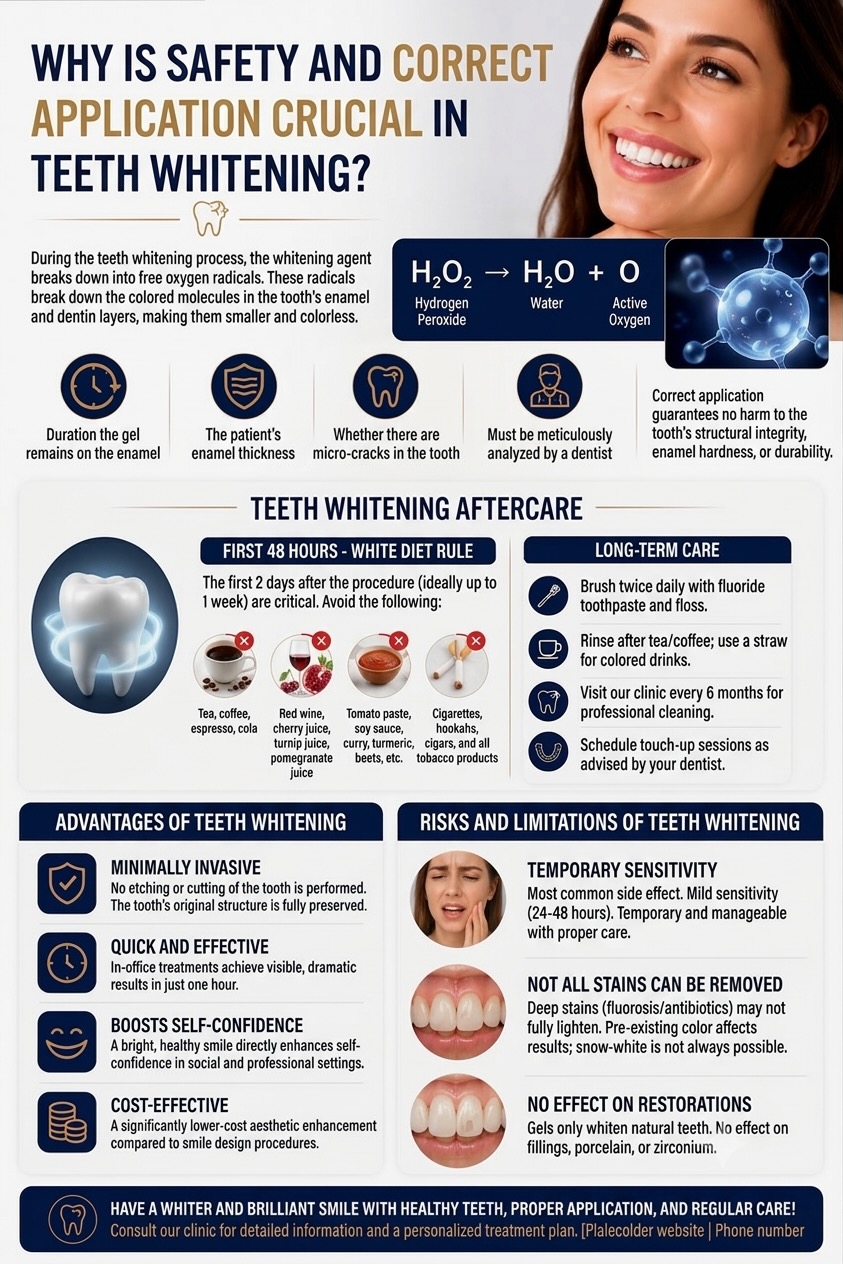
The basic biochemical reaction that occurs during the teeth whitening process is the breakdown of the whitening agent into free oxygen radicals. Chemically, this oxidation process can be summarized as follows:
The active oxygen released here enters between the colored, large organic molecules in the enamel and dentin ducts, breaking them down into smaller, colorless molecules. In order for this chemical reaction to take place safely;
-
Time of gel on enamel,
-
Patient’s enamel thickness,
-
Whether there are invisible microcracks in the tooth,
It should be carefully analyzed by the dentist. When applied correctly, the process does not harm the structural integrity, enamel hardness or durability of the tooth.
Post teeth whitening care
Increasing the permanence of the treatment and maintaining the perfect result is entirely dependent on the patient’s post-procedure attention. After bleaching, the saliva-derived protective membrane (pelicule layer) protecting the enamel surface disappears temporarily and the teeth become very vulnerable to coloration.
First 48 hours (white diet rule):
The first 2 days after the procedure (ideally 1 week) are very critical. Things to avoid in this process:
-
Dark drinks such as tea, coffee, espresso, coke.
-
Red wine, cherry juice, turnip juice, pomegranate juice.
-
Foods containing intense pigments such as tomato paste, soy sauce, curry, turmeric, beets.
-
All tobacco products such as cigarettes, hookahs, cigars.
Long-term maintenance:
-
Teeth should be brushed with fluoride toothpaste at least twice a day and dental floss should be used.
-
When tea or coffee is consumed, the mouth should be rinsed with water immediately afterwards (or drink colored drinks with a straw).
-
Routine dental calculus should be done by coming to our clinic in 6-month periods.
-
If needed, touch-up sessions can be held with home-type plaques during the periods recommended by the physician.
Advantages of teeth whitening
-
It is minimally invasive: zirconium coating Or, unlike porcelain laminated treatments, no etching or cutting is performed from the tooth. The original structure of the tooth is completely preserved.
-
It is fast and effective: In office type applications, a visible, dramatic change is achieved in just one hour.
-
Increases self-confidence: A bright and healthy smile directly raises one’s self-confidence in social and professional life.
-
It is economical: It is a much lower-cost aesthetic improvement method compared to smile design procedures.
Risks and limitations of teeth whitening
-
Temporary sensitivity: It is the most common side effect. Within 24-48 hours after the procedure, tingling can be seen against hot and cold. This situation is completely temporary and can be easily controlled with fluoride treatment to be applied by the physician or with antisensitizing pastes to be recommended.
-
Not every stain may appear: Deep fluorosis spots or severe antibiotic discolorations may not always open at the desired level. The result may vary depending on the current color and structure of the tooth; A completely snow-white (100% white tooth) result cannot be medically guaranteed for every case.
-
Does not affect restorations: It does not whiten the fillers and porcelains, as mentioned earlier.
Frequently Asked Questions (FAQ)
No, bleaching processes by a professional dentist using quality materials (CE/FDA approved) at the appropriate concentration do not harm the tooth enamel. The chemical oxidation process does not disrupt the structure of the tooth, it only breaks down the color pigments inside the tooth.
Costs vary according to the preferred method. As of 2024, our clinic starts from 3,500 TL, single session clinic (office) type whitening starts from 5,000 TL, and combined systems that provide maximum effect from 7,500 TL. Net pricing becomes clear after inspection.
Clinic (office type) laser/LED supported methods are usually completed in a single 45-60 minute session. When deemed necessary, the second session can rarely be applied. Home-type methods, on the other hand, require 1 to 3 weeks of regular home use.
The resulting whiteness maintains its permanence for an average of 1 to 3 years. It is not permanent for life. duration of the result; It is directly dependent on the patient’s smoking, tea/coffee consumption and daily oral care routines.
Yes, during the first 24-48 hours after the procedure, it is a completely normal and temporary condition that mild/moderate tingling and tenderness against cold or heat occur in the teeth. With the use of fluoride gels and desensitization paste applied in our clinic, this process is overcome very comfortably.
The mechanism of action of both is different. Clinical type (office) provides an instant, fast and strong whiteness. The household type, on the other hand, offers a slow but more permanent color stabilization. Our clinic recommends the “combined whitening” method, in which both are used together for the most successful result in stubborn stains.
No, bleaching gels only act on natural tooth tissue (mine and dentine). Composite fillings, porcelain veneers or zirconium teeth available in the mouth do not change color. After bleaching, these restorations may need to be changed in accordance with the new light color.
Since there is not enough clinical study on the effect of hydrogen peroxide in whitening agents on the baby in the womb or breast milk during the breastfeeding period, whitening of teeth during pregnancy and lactation is not medically recommended.
Cheap, unapproved kits made outside the control of a physician in beauty centers or sold on the internet are extremely risky. Using the wrong content can cause permanent wear on the enamel and serious chemical burns (necrosis) as a result of the gel leaking into the gums. For safety, you should always prefer the clinical environment.